
Mars Robotics Association doesn’t meet in a school classroom. There’s no bell schedule. No credit hours.
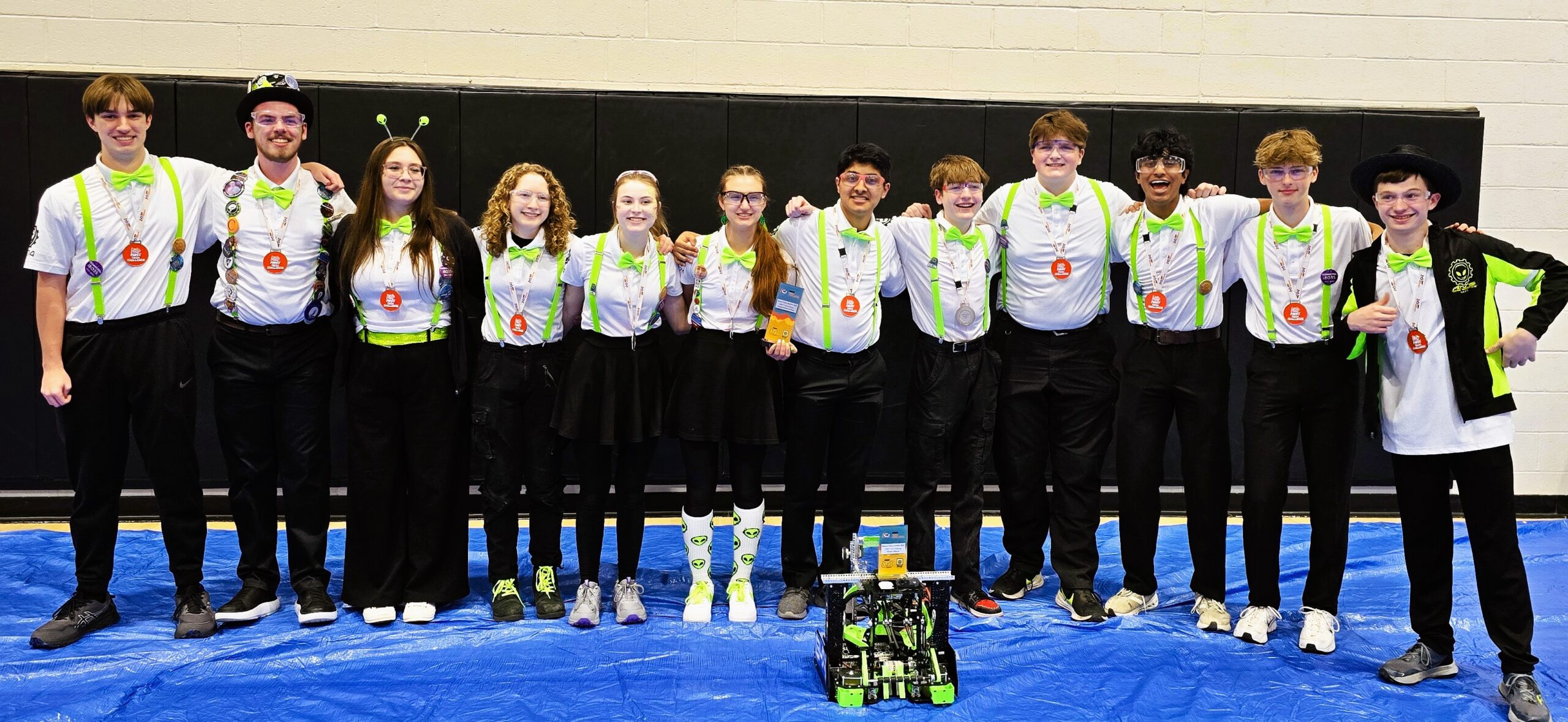
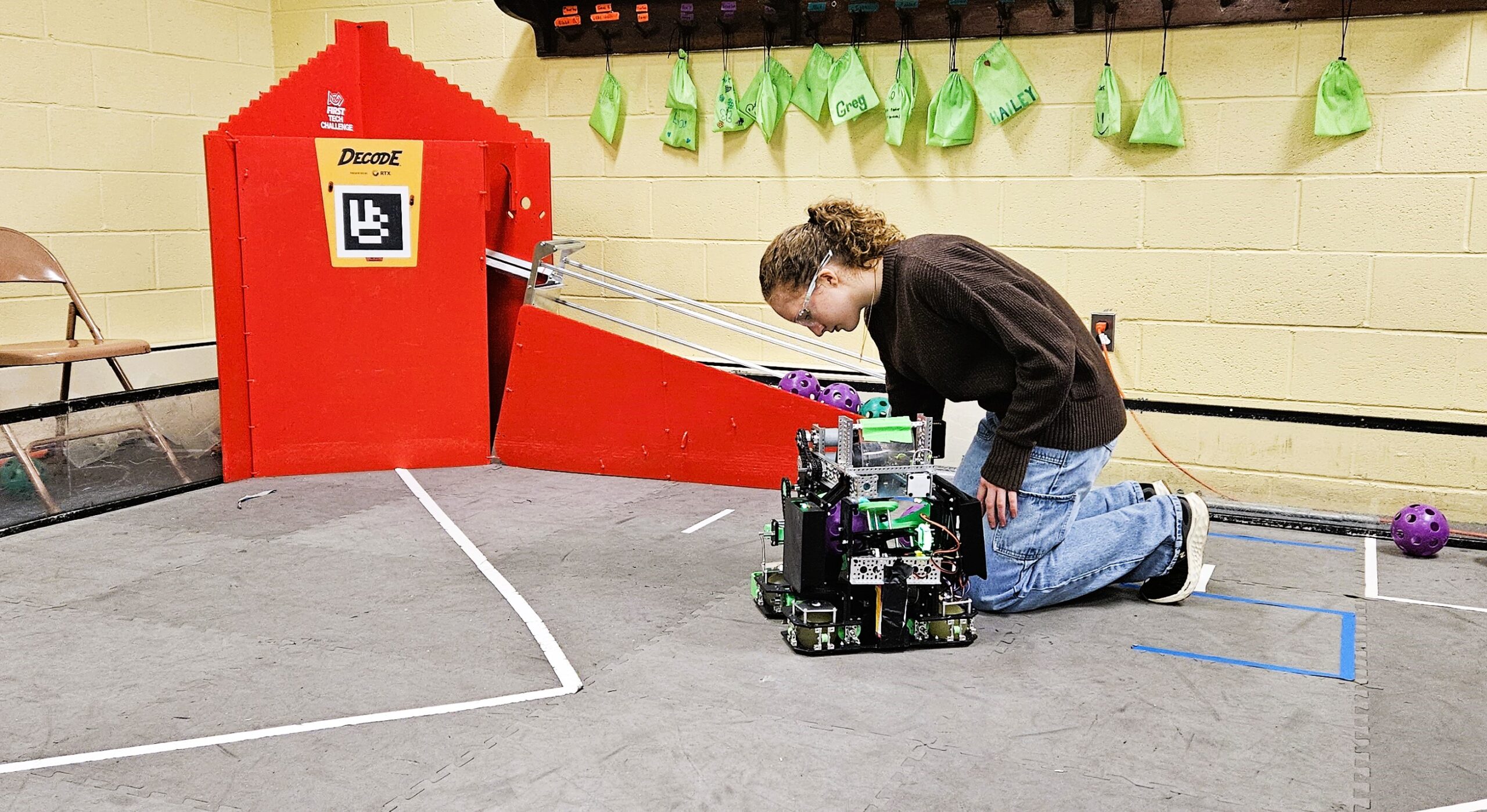
Instead, there are whiteboards filled with sketches, laptops open to CAD models, 3D printers humming, and a robot named “F.R.Q.N.T.” — a name the students created that doesn’t officially stand for anything — rolling across the floor on ball-driven wheels, one of the most innovative designs in the state.
And in just a few weeks, the Curiosity team will take that robot to the Pennsylvania State Championship in the FIRST Tech Challenge.
Designing From Scratch
When the annual game is revealed in late August, every team across the state receives the same challenge.
This year’s task? Build a robot capable of collecting five-inch diameter wiffle balls, sorting them by color, scanning AprilTags (similar to QR codes), and shooting them into scoring zones with precision.
From that moment, the clock starts.
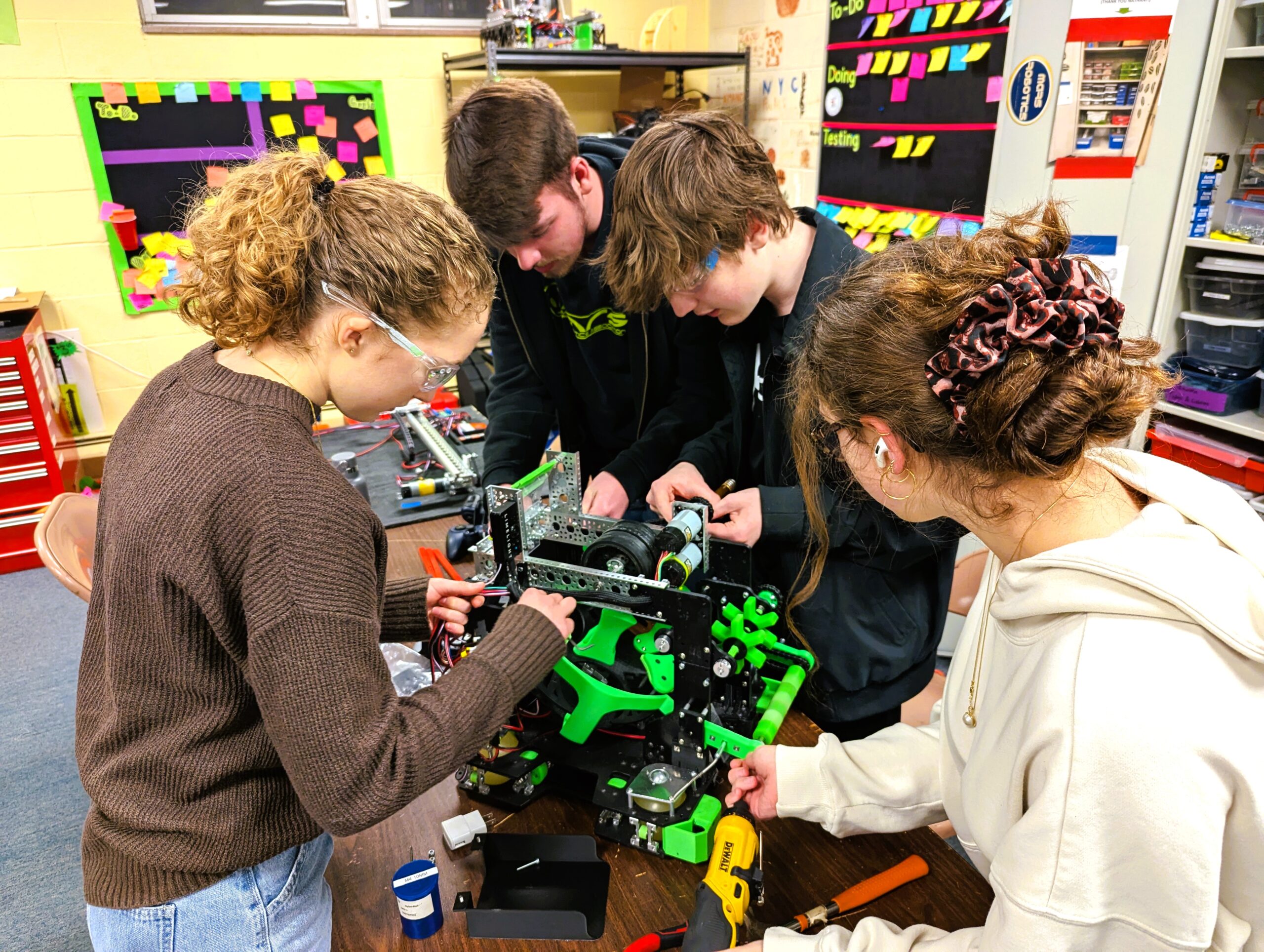
“We start with sketches and discussions,” said Colby Kohnen, a senior and longtime team member. “Then we build cardboard prototypes. Then we move to CAD drawings, 3D printing, machining and testing.”
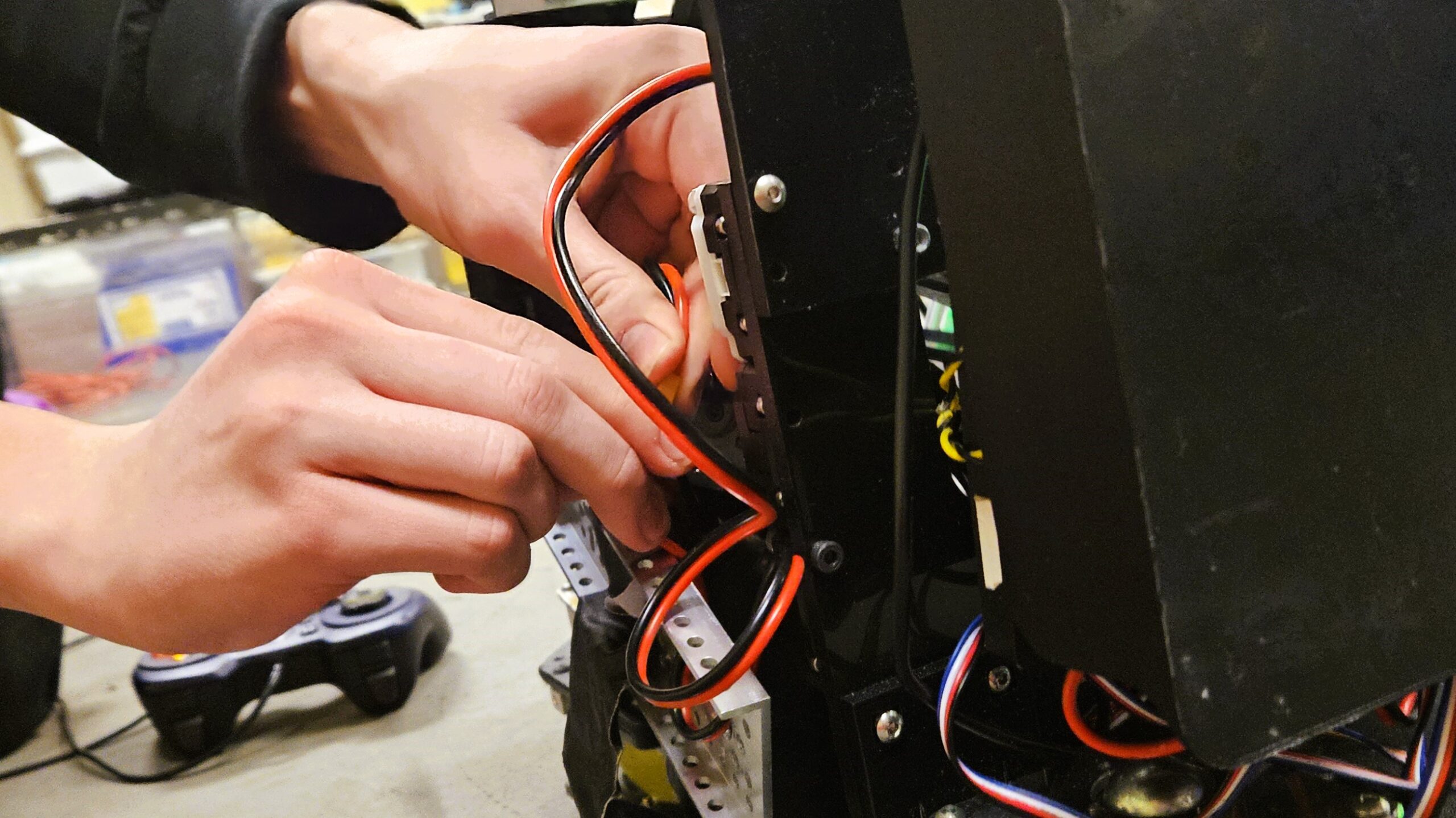
Nearly everything on F.R.Q.N.T. is custom-built.
The chassis rides on rubberized spherical drive modules instead of traditional wheels — allowing it to move in all directions with speed and torque. Plastic components are student-designed and 3D printed. Aluminum plates are CNC-machined with help from local businesses. The programming team developed equations that automatically adjust shooting velocity based on field position.
The robot can launch balls from as far as 15 feet away.
But distance isn’t what wins competitions.
“Accuracy is the biggest part of this game,” Alex Hutchens explained. “If you’re fast but not accurate, you lose.”
Engineering Is Iteration
What stands out most about Curiosity isn’t just innovation — it’s process.
Nothing on the robot was built once.
Everything was tested, rebuilt, redesigned and refined.
“This is probably the fourth version of our indexer,” one student said, referencing the internal mechanism that organizes the balls before they’re shot.
Mechanical systems must balance speed with reliability. Programming calculates angles and velocity across a mapped coordinate system. Sensors detect AprilTags to automatically aim and determine scoring order.
“It’s about trade-offs,” said Alex. “How do you maximize speed without sacrificing accuracy? How do you improve torque without losing control?”
Failure is part of the design cycle.
Last year, the team brought a creative design to competition that ultimately proved unreliable. It broke the night before the event — and again during competition.
The lesson?
“Don’t be afraid to change your design,” said Colby, the team’s project manager. “Do your research. Test it. If it fails, that’s okay.”
That mindset is engineering in its purest form.
More Than Mechanics
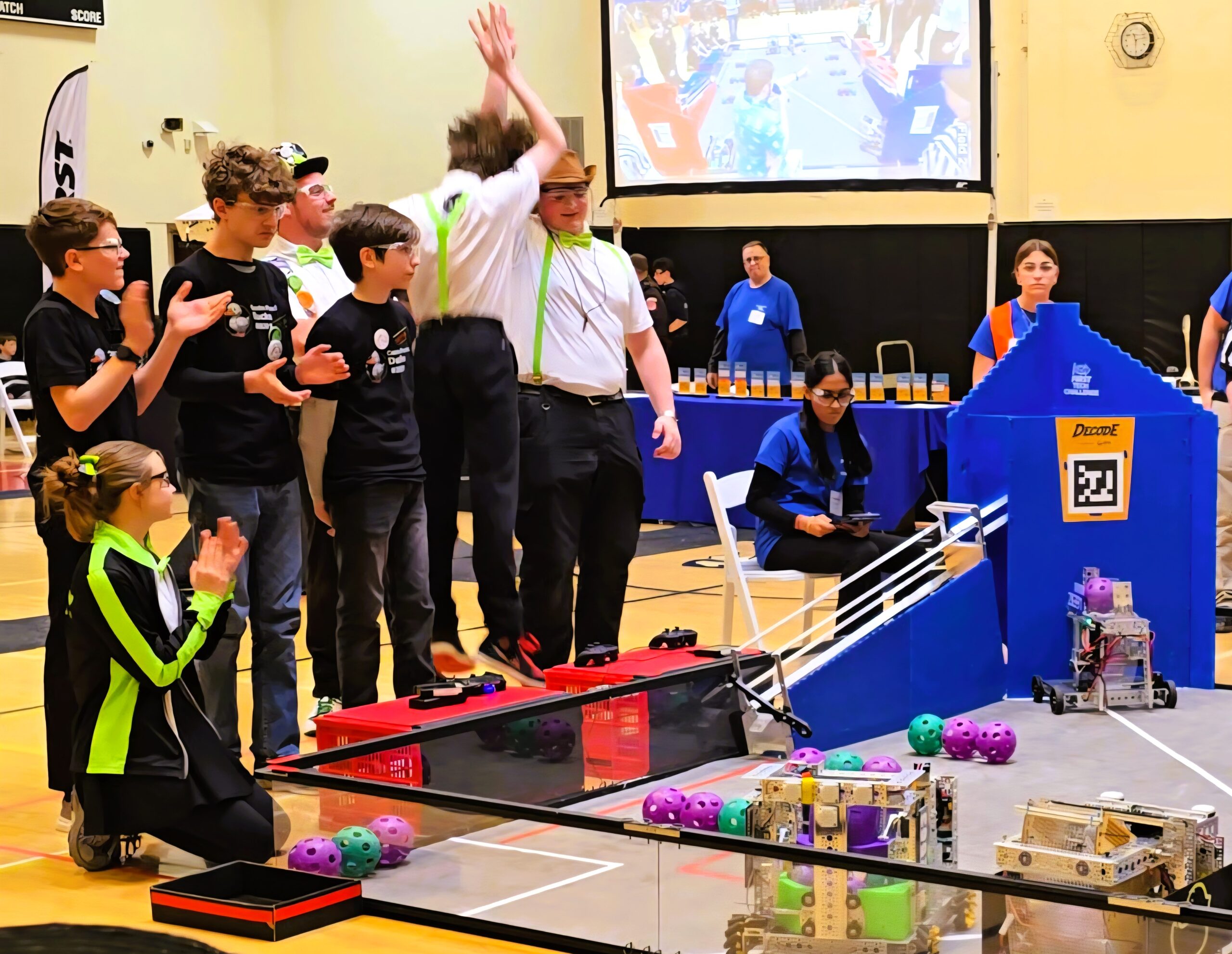
The Curiosity team includes 14 students. Some specialize in programming. Others in mechanical design. Others handle outreach, documentation, and presentations to judges. Team members include Alex Hutchens, Audrey Anderson, Colby Kohnen, Emma Salasky, Eshan Kazi, Grigory Parkhitko, Hailey Tomsik, Isaac Hanson, Max Kant-Zajac, Nate Taylor, Rohit Doijad, Santiago Beltran, Sophia Gourash, and Tatum Empey.
And it’s organized like a professional engineering firm.
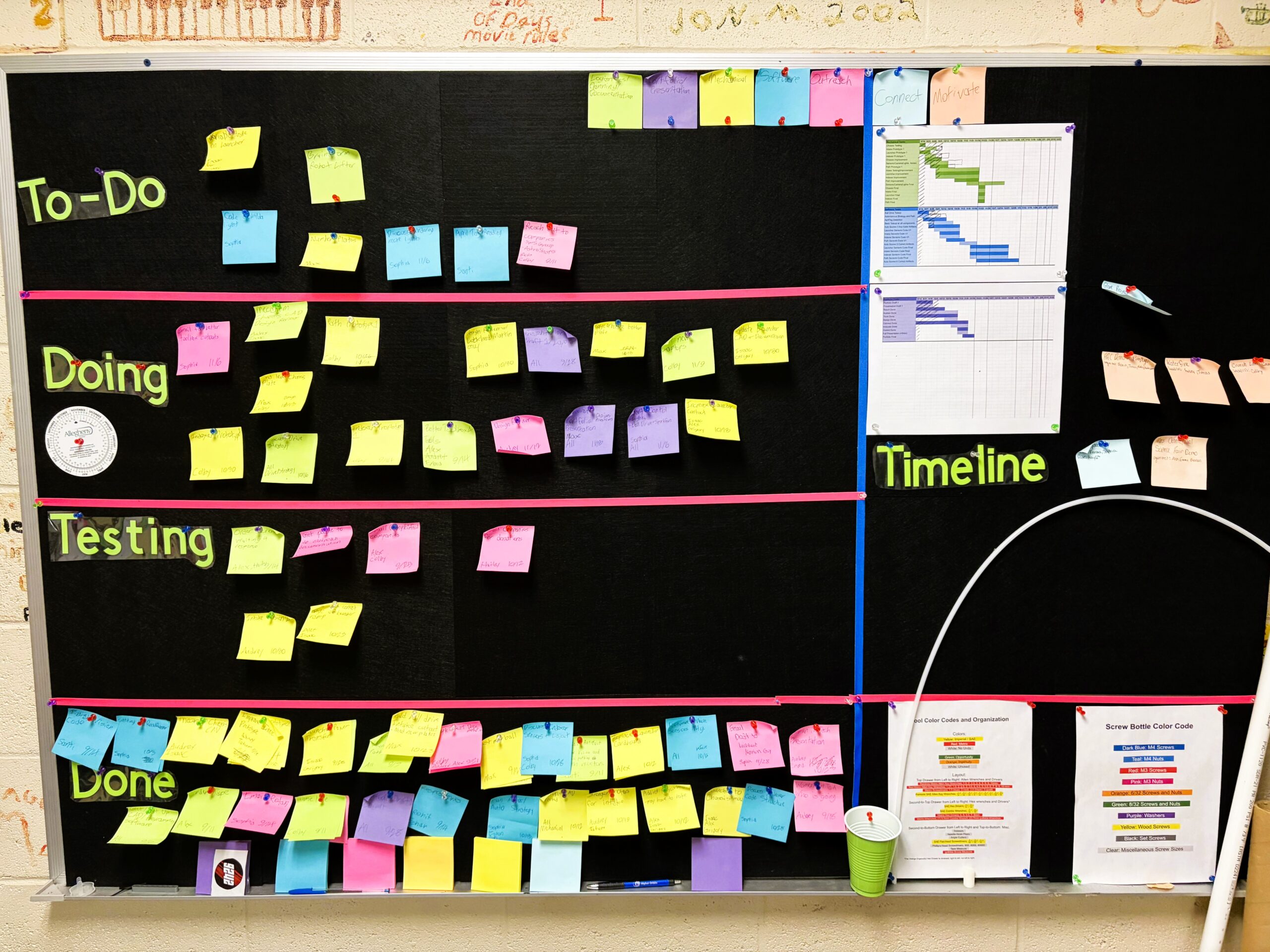
Audrey Anderson, an 11th grader, serves as the team’s mechanical lead, while Colby Kohnen, a 12th grader, manages the project workflow, overseeing a Kanban board that tracks dozens of color-coded tasks — mechanical, programming, outreach and portfolio development.
Every task has an owner. Every task has a deadline.
“We assign everything during meetings,” explained Kohnen. “We make sure everyone is doing something — and not too much.”
At the beginning of the season, the team builds a Gantt chart timeline to map milestones. If they fall behind, they schedule additional meetings.
All CAD files, programming, documentation, and resources are stored in a shared drive — just like a real-world engineering team.
In total, the robot likely represents 50 to 100 completed tasks this season alone.
Skills You Can’t Learn in a Classroom
Several students said they entered the program knowing little or nothing about robotics.
Alex began with Lego League and eventually moved into FTC. Today, he has completed Butler Vo-Tech’s machinist program and is pursuing certifications through NIMS, with a job lined up at Oberg Industries.
“This definitely taught me what I want to do,” said Alex. “I like working with my hands.”
Colby also recently toured an architecture firm and was accepted into Penn State’s architectural engineering program.
Audrey discovered a passion for mechanical design after initially starting in outreach. This season, she custom-designed silicone intake brushes because she wasn’t satisfied with off-the-shelf parts.
“I didn’t think I’d be able to do it,” she said. “But I figured it out.”
All three students said robotics significantly influenced their career direction.
But technical skills are only part of the story.
Public speaking. Conflict resolution. Leadership. Time management.
“I used to be really shy,” one student said. “I wouldn’t even talk to my teachers. Now I love talking to people.”
A Mentor’s Perspective
Erik Anderson has been mentoring for seven years. He also happens to be Audrey’s father.
For him, the most rewarding part isn’t trophies.
It’s transformation.
“They didn’t believe they could compete with the best teams in the state a year or two ago,” he said. “And now they’ve taken it to an entirely different level.”
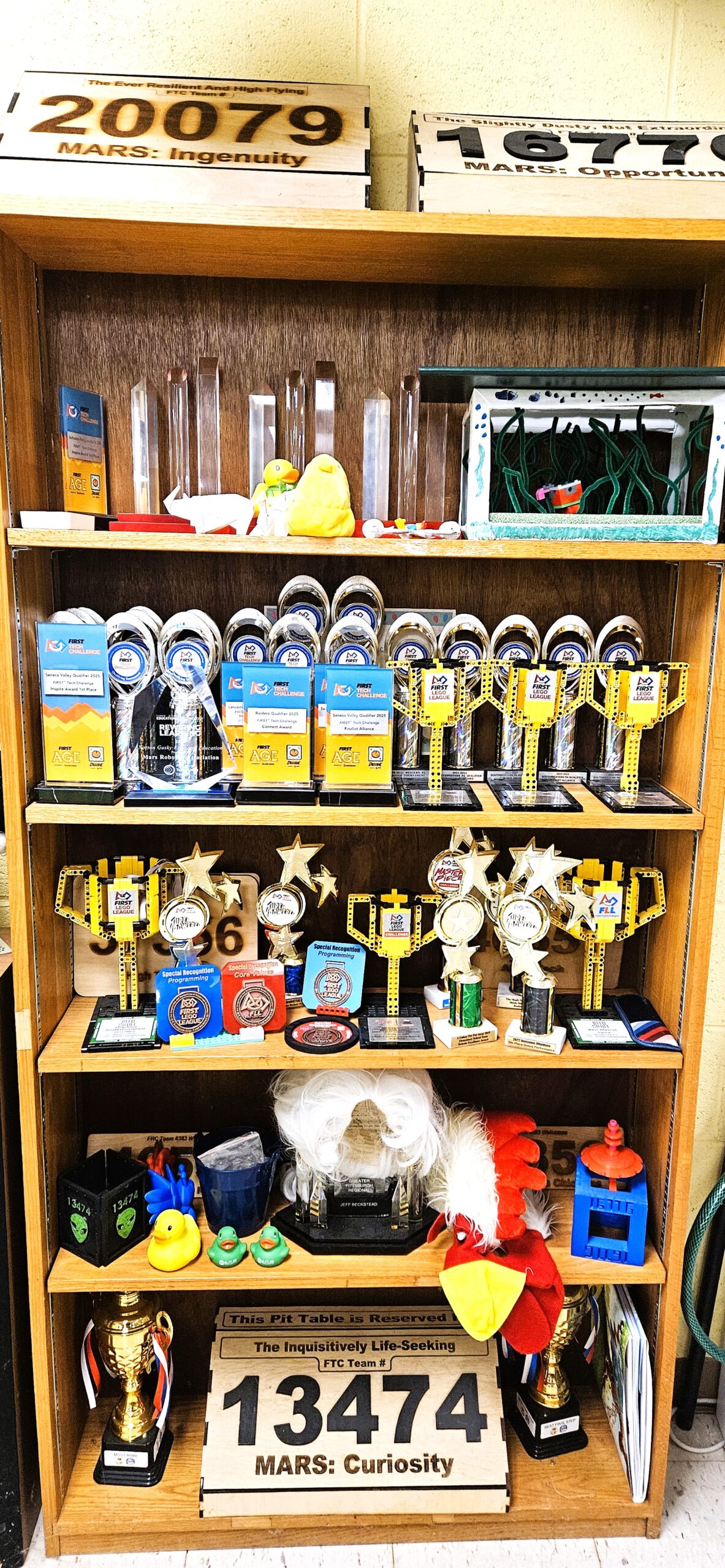
Curiosity qualified for states after making finals at the Seneca Valley Qualifier on January 10 and winning the prestigious Inspire Award — one of the highest honors in FTC. The award recognizes teams nominated across multiple categories, including robot performance, outreach, and detailed engineering documentation. Among 16 competing teams, Curiosity earned the highest advancement-point award at the event. To qualify, teams must be nominated for at least one robot award, one outreach award, and the Think Award, which evaluates engineering documentation and design process.
There’s pressure that comes with reputation.
“People know who we are,” Erik said. “They expect us to perform at a certain level.”
But he works carefully to balance expectations with growth.
“If you have a bad day, that doesn’t mean you didn’t perform at a high level.”
He’s watched students learn how to handle failure, rebuild confidence, and choose the harder path when given the option.
“I had to join the military to learn some of these lessons,” Erik said. “They’re getting them five years earlier.”
And increasingly, alumni are returning as mentors — creating a self-sustaining pipeline of talent and leadership.
 Beyond Competition
The Mars Robotics Association recently celebrated its 10th anniversary. The nonprofit includes five teams across different age levels and draws students from roughly a dozen schools.
The students even run a branded soda business — Red Planet Soda — to help fund operations and teach entrepreneurship.
Last summer, they built robotic musical instruments and performed a custom piece called Minerva during the Mars New Year festival, collaborating with a composer from California.
Engineering meets creativity. Mechanics meets music.
The Road to States
The Pennsylvania FTC Championship will take place March 14–15 at Saucon Valley Middle School in Hellertown. Forty teams will compete, and only six will advance to the FIRST World Championship in Houston.
And now, their biggest test awaits.
But regardless of outcome, something bigger has already happened.
They’ve learned how to design from scratch.
How to test and iterate.
How to debate ideas and resolve conflict.
How to build something that didn’t exist six months ago.
And perhaps most importantly — how to believe they can compete with the best in the state.
For a group named Curiosity, that may be the greatest accomplishment of all.