

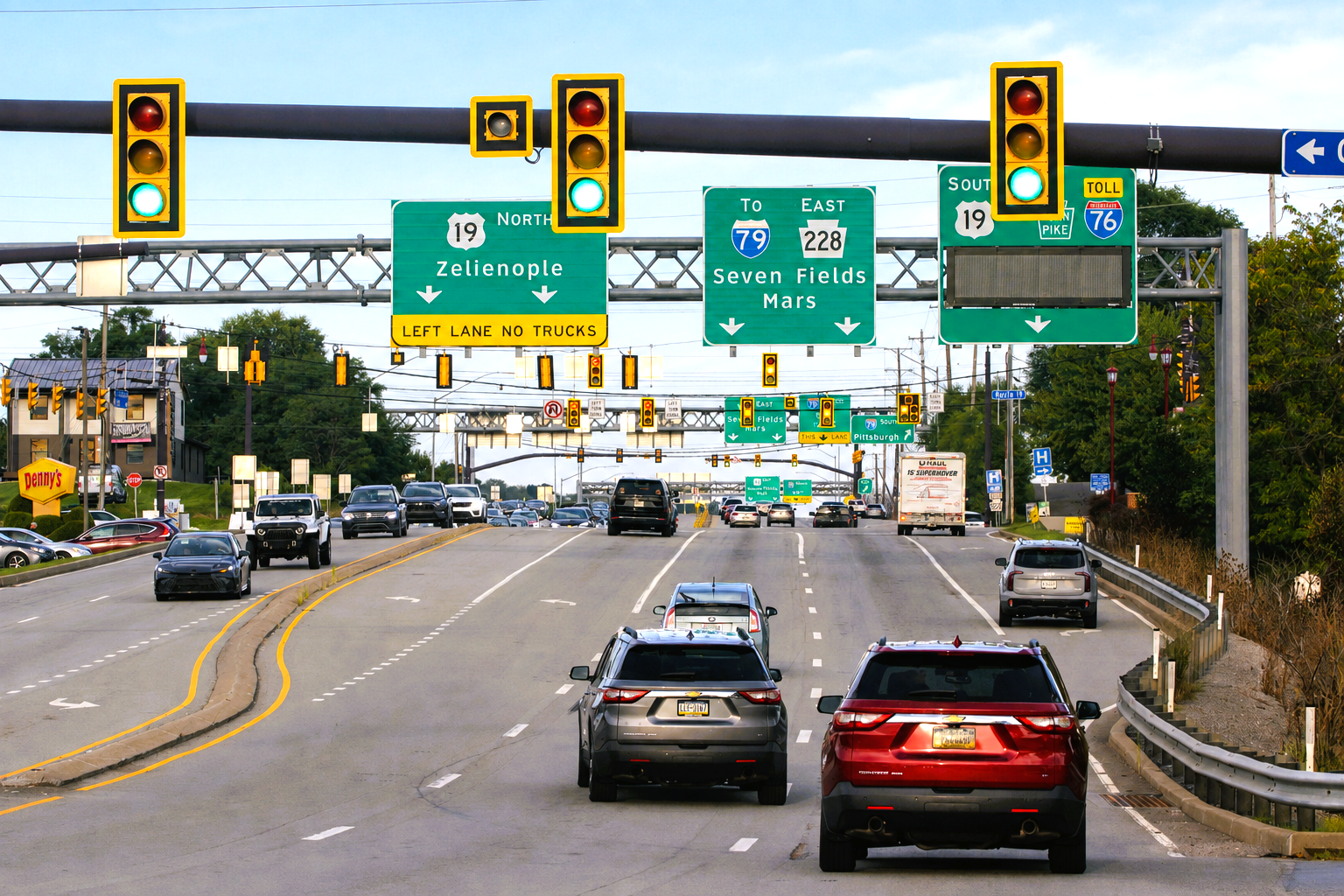
CRANBERRY TWP. — More than 100,000 vehicles move through the intersection of Route 19 and Route 228/Freedom Road on a typical day, making it one of the busiest crossroads in the region.
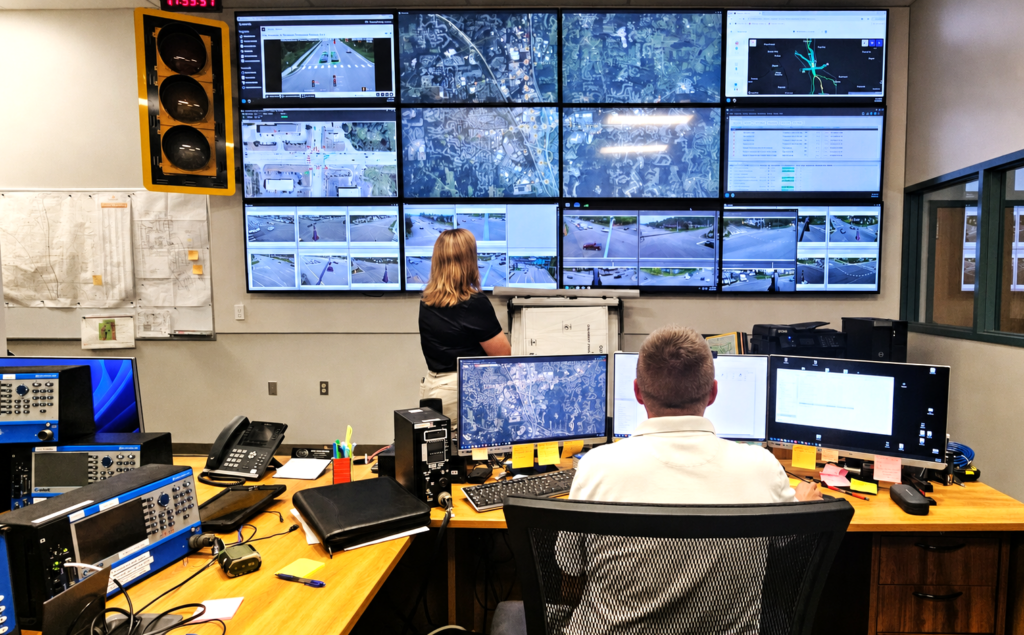
But a short distance away, inside a room lined with 12 large television screens, a small Cranberry Township traffic team is watching.

As work continues to improve the Route 228 corridor, including plans for the remaining section between Franklin Road and the Mars Railroad Bridge — The 228 Times went behind the scenes at Cranberry Township’s Traffic Operations Center to see the technology and meet the people, responsible for keeping thousands of vehicles moving every day.
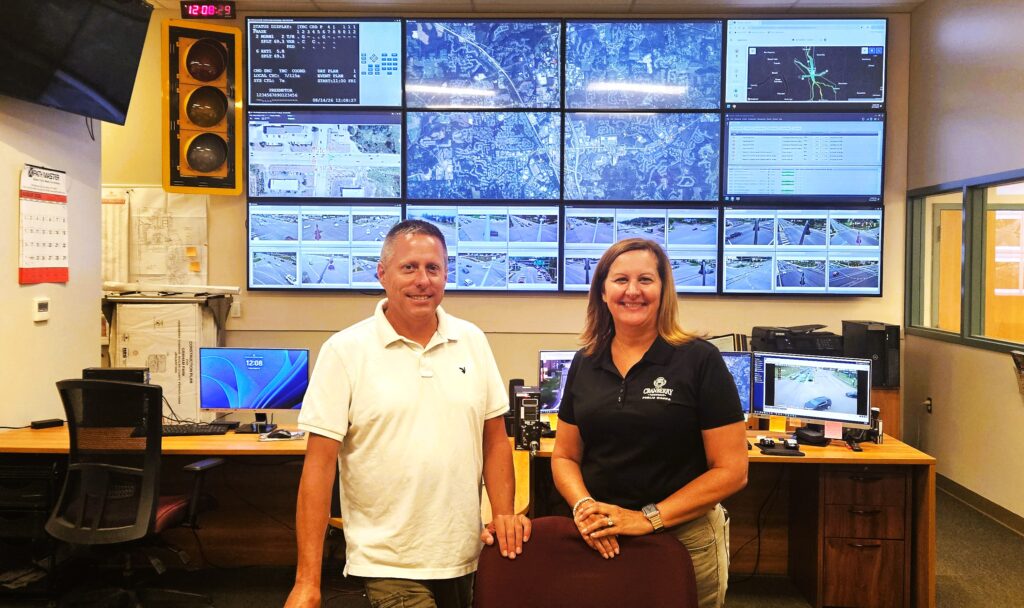
Shane Wokutch, Cranberry Township’s manager of traffic operations, and Public Works Director Kelly Maurer stand inside the township’s Traffic Operations Center, where employees monitor intersections and coordinate traffic signals throughout Cranberry and neighborhood communities.

The center can also check the timing of every traffic signal connected to its system.
That system doesn’t stop at Cranberry’s municipal boundaries.
In addition to Cranberry Township’s signals, the center monitors four signals in Marshall Township, three in Seven Fields and four in Adams Township. Along Route 228, Cranberry’s coordinated system extends east to the Heritage Creek intersection.
The reason, Public Works Director Kelly Maurer explained, is simple: traffic doesn’t stop at municipal boundaries.
The major corridors running through Cranberry carry motorists between communities and eventually toward Interstate 79 and the Pennsylvania Turnpike. Coordinating signals across those boundaries can help keep that traffic moving.
More Than a Timer
For motorists sitting at a red light on Route 228, it may sometimes seem as though a traffic signal is simply operating on a timer.
What’s happening behind the scenes is considerably more complicated.

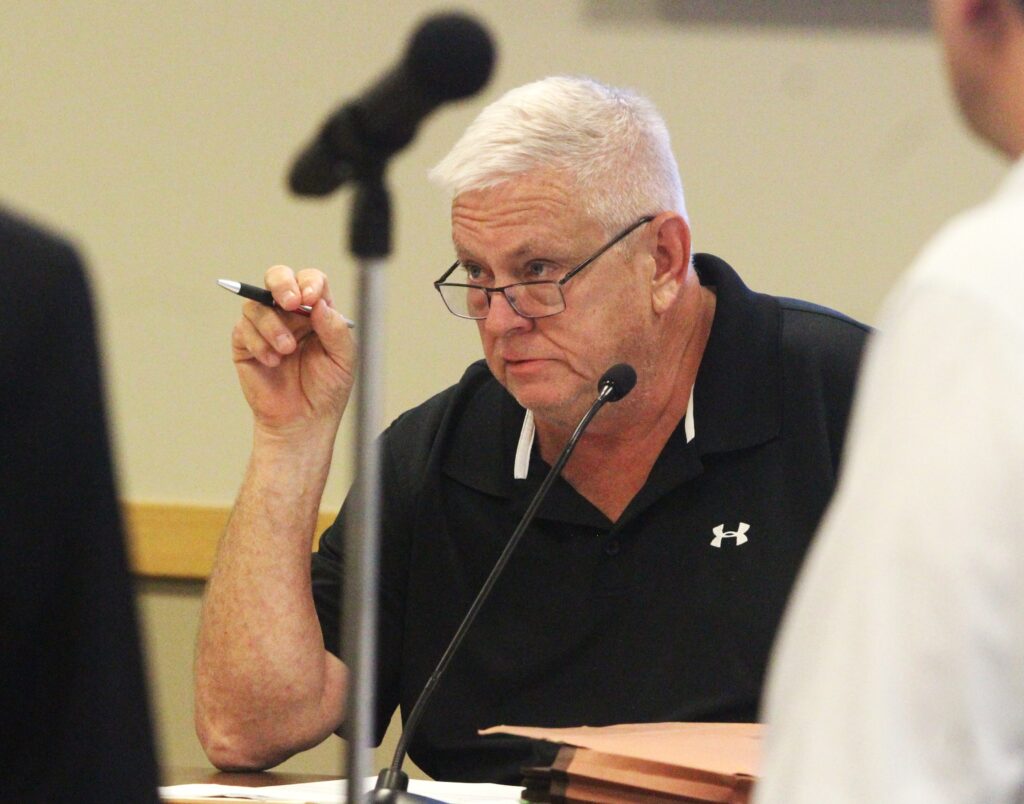
Marty McKinney, president of the Adams Township Planning Commission, watched much of that evolution from the inside.
Before retiring, McKinney spent 25 years working in traffic operations for Cranberry Township and ultimately served as the township’s manager of traffic operations. He has also served on the Adams Township Planning Commission for about 20 years.
McKinney said he was involved in developing what became Cranberry’s modern traffic-control system as the township looked for better ways to manage its rapidly growing traffic.
A major opportunity came when Westinghouse moved into Cranberry Township. McKinney said infrastructure funding associated with the development was available for local improvements, and township officials asked what could be done to upgrade the traffic system.
The result, he said, was hundreds of thousands of dollars that helped Cranberry expand its communications platform, upgrade equipment and build a more sophisticated traffic-management system.

“They’re still building,” McKinney said.
The system continues to expand as new technology becomes available, allowing Cranberry to add equipment, collect information and evaluate new approaches to moving traffic.
That evolution is readily apparent today.
Years ago, engineers periodically analyzed traffic and manually retimed signals. Today, the signals can adapt to changing traffic conditions in real time.
“They are always counting the cars and setting the times of the signals and the offsets from signal to signal in real time,” Maurer said.
That means the amount of green time motorists receive can change as traffic conditions change.
The system has base timing plans, but it can make adjustments as vehicles move through the corridor.
That becomes especially important at Route 19 and Route 228/Freedom Road.
Township officials estimate approximately 100,000 vehicles travel through that intersection each day. Route 19 carries roughly 50,000 vehicles, while Route 228 and Freedom Road each carry about 30,000, according to figures discussed during The 228 Times’ visit.
The complete traffic-light cycle at the intersection can range from approximately 120 to 170 seconds depending on the time of day.
Everything from when a left-turn arrow appears to how long motorists receive a green light is intended to move as many vehicles through the intersection as efficiently as possible.
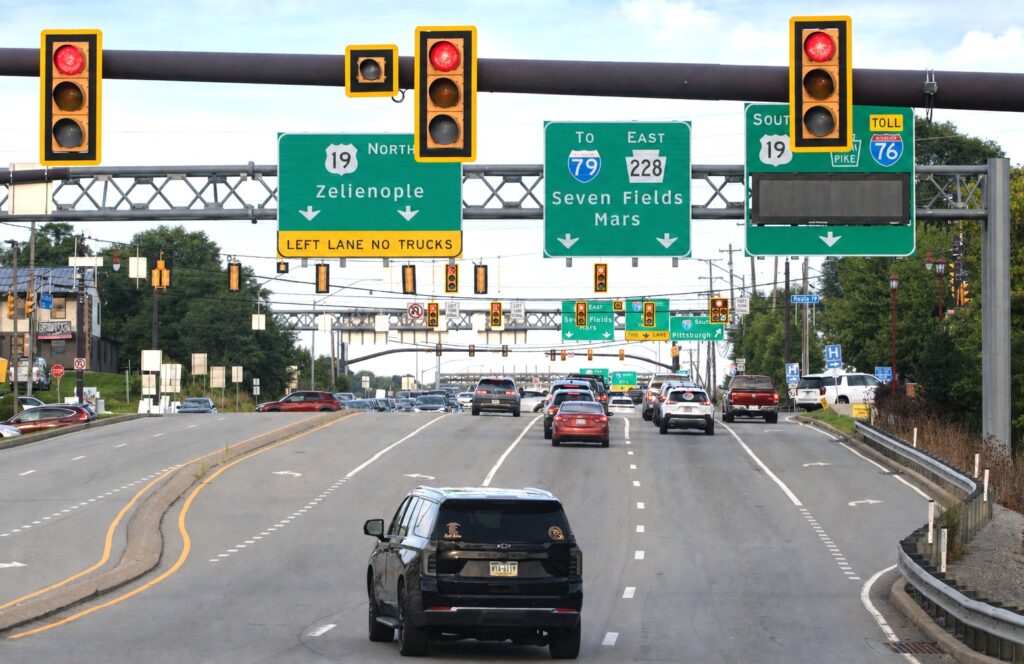
Why You Sometimes Hit Every Red Light
So why can a driver still seemingly hit every red light on Route 228?
The answer involves where the vehicle enters the system and what else is happening along the corridor.
The signals are primarily coordinated around the through movement of traffic. A motorist traveling with that flow should, under ideal conditions, begin seeing green lights ahead.
But a driver entering Route 228 from a side road isn’t necessarily entering at the same point in the coordinated cycle.
Pedestrians can affect the cycle, too. Someone activating a pedestrian crossing can temporarily disrupt the progression before the signals work themselves back into synchronization.
And the Cranberry system currently ends at Heritage Creek in Adams Township. Signals farther east toward the Mars Area schools are not part of Cranberry’s coordinated network.
The system also responds differently late at night. Around 10 p.m., signals generally begin operating independently rather than as part of the daytime coordinated pattern, allowing vehicles approaching from side streets to be detected rather than making motorists wait unnecessarily when traffic is light.
Watching Route 228 in Real Time
Across the bottom row of monitors inside the Traffic Operations Center are live camera views of intersections throughout the area.
Operators can pan, tilt and zoom some of the cameras to examine traffic conditions.
If vehicles begin backing up, employees can see it.
If a crash blocks traffic, they may see that, too.

“We get alerts on our computers and cell phones if we have issues out in the field that need addressed,” Wokutch said.
Township employees said approximately 90 percent of signal problems can be diagnosed from the center before a technician is sent into the field.
In some cases, timing can even be changed remotely.
That ability becomes especially important during crashes, road closures and other events that suddenly send vehicles onto roads that normally wouldn’t carry that volume.
The township also sends traffic alerts to approximately 5,000 subscribers when planned or unplanned incidents could affect motorists.
The center’s cameras serve another purpose. Video is recorded and retained for approximately a week and can be requested, making the footage useful following crashes and other incidents.
The People Behind the Technology
Eventually, however, somebody still has to go outside and fix the traffic light.
That’s where Richard Toth and Cranberry Township’s traffic maintenance staff come in.
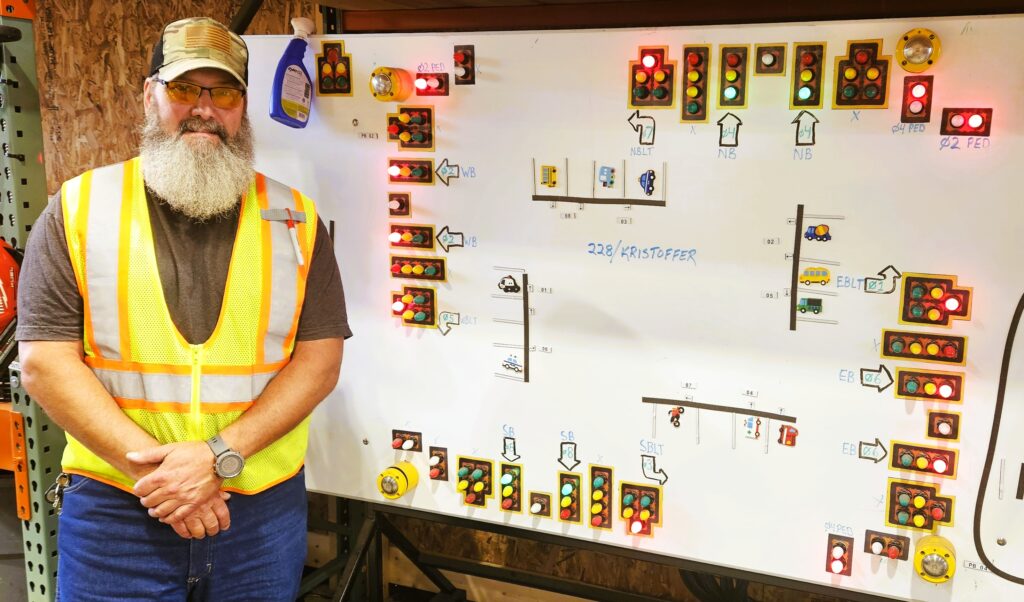
Toth, crew leader for the traffic department, showed The 228 Times what happens inside the metal traffic-control cabinets motorists see beside intersections.
“The brains of the operation is your controller,” Toth said.
Another device, called an MMU conflict monitor, continually checks the electrical operation of the intersection.
If it detects something that shouldn’t be happening — including an electrical conflict that could potentially produce an unsafe signal indication — the system can place the intersection into flash within milliseconds.
Toth also maintains a test traffic-control cabinet inside the township’s maintenance facility.
It can be wired and programmed to simulate any intersection in Cranberry Township.
Before new equipment is installed along a roadway, Toth can configure the cabinet for that particular intersection and let it operate for days or even weeks. Pedestrian buttons can be tested. Signal sequences can be checked. Problems can be identified before the equipment ever reaches the roadway.
The township also performs preventative maintenance on its traffic signals every year, checking equipment, emergency vehicle preemption, signs, road markings, pedestrian crossings and other components.
That doesn’t eliminate every emergency.
Trucks occasionally strike signal equipment. Pedestrian equipment can be damaged. Electrical components fail.
And sometimes the problem is considerably smaller.
Ants have even found their way inside the equipment.
Toth recalled one malfunction that was difficult to diagnose until he picked up an MMU and ants began spilling out of it.
When Emergency Vehicles Approach
The traffic signals also play a role in helping emergency responders.
Signals in the system have emergency vehicle preemption technology.
When an emergency vehicle approaches using the appropriate audible signal, the traffic signal can recognize it and provide a green indication in the direction the emergency vehicle needs to travel.
The system is particularly important because of emergency services and medical facilities in the Cranberry area.
During power failures, the township is also working to keep major intersections operating. Officials said roughly half of the traffic signals have battery backup, with an emphasis on the major corridors, while the Traffic Operations Center itself is backed by a generator.
The computer system also has redundancy, with servers in separate township buildings.
Preparing for More Traffic
Keeping traffic moving has become increasingly important as development continues throughout the Route 228 corridor.
New developments are required to complete traffic studies and mitigate their impact on the roadway network.
That planning extends to major developments such as Cranberry Springs and the Wegmans store now under construction.
But perhaps the biggest change still ahead is the continued reconstruction of Route 228 itself.
Maurer described the remaining unwidened portion of Route 228 as a “missing piece” in the corridor.
Traffic can bottleneck where the roadway narrows, with backups sometimes extending through the Franklin Road intersection.
Widening that section could do more than provide additional roadway capacity.
Township officials hope fiber-optic cable will be installed through the project area, improving communication between traffic signals and the Cranberry Traffic Operations Center.
Some communication currently relies on radio links, which officials said aren’t as reliable as fiber.
“If that was widened, then we’d be able to synchronize these signals even better and move more traffic,” Maurer said.
Cranberry Township has used grants extensively to build and continually upgrade the system. Maurer said the township has leveraged approximately $10 million in grant funding during the past decade for traffic signal improvements and technology.
The investment isn’t ending.
Township officials are already looking at artificial intelligence, predictive traffic technology and the eventual ability for traffic signals to communicate directly with vehicles.
Cranberry has also worked with Carnegie Mellon University on traffic technology projects — a relationship between the township’s traffic operation and academic researchers that goes back years.
McKinney said Cranberry’s ability to collect large amounts of traffic data led to collaborations with Carnegie Mellon, Purdue and Clemson universities. Researchers were able to use that information to study technologies and approaches that are now part of the broader field of intelligent transportation.
“Intelligent transportation is a big deal,” McKinney said.
McKinney said PennDOT also saw value in Cranberry’s system because the township could collect information and provide an environment where new traffic-management products and technologies could be evaluated.
Today, one system can use traffic information from Interstate 79 to give the township advance warning that additional vehicles are about to reach Cranberry.
In the future, connected vehicles could potentially communicate with the traffic signals themselves — allowing a vehicle to know, for example, that a signal ahead is about to turn red.
For now, however, there are still people behind the technology.
Maurer emphasized that Cranberry’s traffic system isn’t simply programmed and forgotten.
Employees monitor it, analyze it, maintain it and continually make adjustments.
For Wokutch, one of the rewards comes when all of that work is nearly invisible to the motorist.
Drive down Route 19 or Route 228 when the system is working just right, he said, and motorists can watch the green lights appear ahead of them as they continue down the corridor.
That’s when the system is doing exactly what it was designed to do.
And for the thousands of motorists traveling Route 228 every day, perhaps the best traffic signal is the one they barely notice.