

As Adams Township and Mars Borough move one step closer to a historic merger, local historians say preserving the community’s identity has never been more important.
Adams Township supervisors unanimously approved an addendum Tuesday, July 28 to the proposed merger agreement with Mars Borough, completing the final municipal action before the question can appear on the Nov. 3 general election ballot. Township officials said the revisions were administrative in nature and did not alter the terms of the proposed merger.


The action follows a 5-1 vote by Mars Borough Council last week approving the same addendum after a request from the Butler County Bureau of Elections.
While voters will ultimately decide the merger in November, many residents have wondered whether Mars’ distinctive identity could be lost. Local officials and historians insist it will not only survive—it will thrive.
“I think it’s another chapter… another chapter that will not be frowned upon,” said John Watson, president of the Mars Area History and Landmarks Society.

Preserving Small-Town Roots
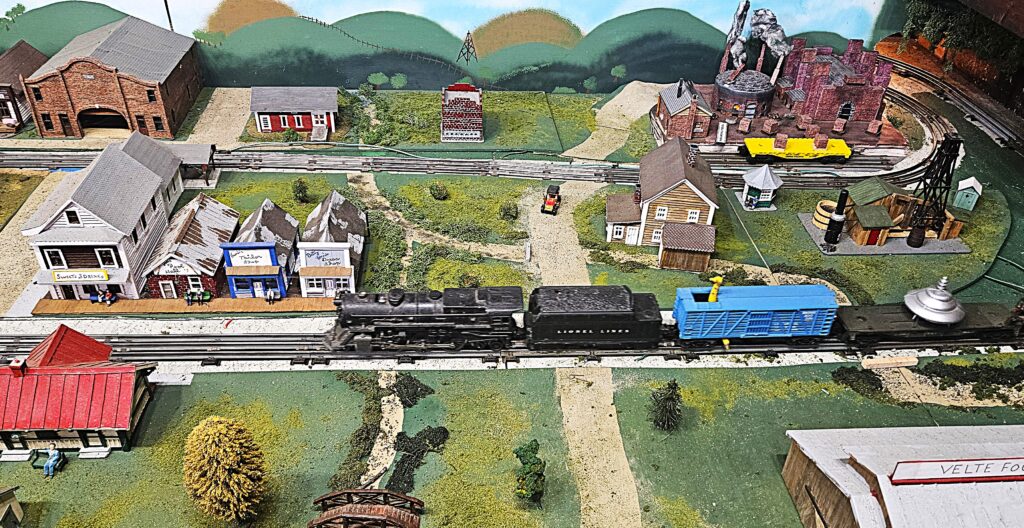
Watson has been leading the effort to keep the story of Mars alive. His work is on full display at the Mars Area Landmarks and Historical Society museum, where a vast array of industrial artifacts is preserved for visitors. Exhibits include railcars, oil derricks, outdated construction machinery, vintage signage from bygone local businesses, retro telephones, a working telegraph, and a detailed diorama of the town circa 1930. There is even a mummified cat, Chessie, that once served as the train station’s mascot.

The museum relies on donations from Mars community members who contribute both cash and long-held family heirlooms. The society’s goal is to preserve the rich history of a town that traces its roots back to the 1870s.
The historical society is housed inside the former Mars train station, which was moved down the street from its original site. Built for the Butler Short Line, it was once the primary rail line connecting Butler County with Pittsburgh, serving as a vital transportation link for Western Pennsylvania’s oil and coal trades.

The Flying Saucer and the USS Mars
Preserving history is no small task, even for a small town. Like most local lore, Mars’ origin story is somewhat clouded and subject to debate. One popular theory attributes the name to founder Samuel Parks’ wife, who had a penchant for astronomy. Others believe it is a shortening of the surname Marshall, honoring Samuel Marshall, the town’s first postmaster.
Whatever the origin, the name “Mars” has become the town’s defining feature—a humorous, otherworldly title for an otherwise classic American town.
“Mars is such a silly name, and that’s a selling point,” explained Watson.
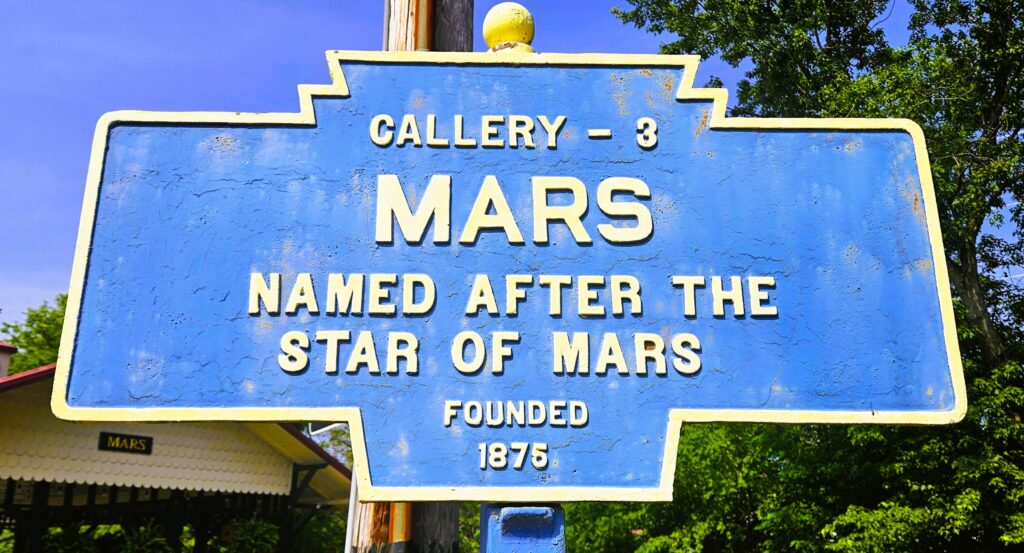

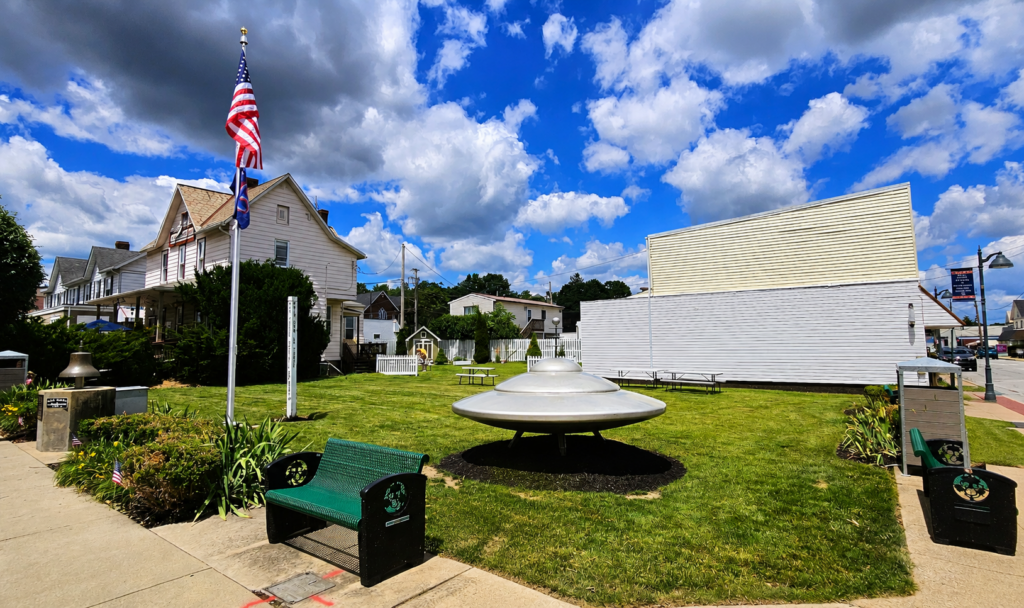
Further adding to the town’s spunky nature is a wrought-iron plaque downtown that erroneously identifies the red planet as a star. But the crown jewel of the town’s space-themed identity sits right in the town square: the famous 3,000-pound flying saucer.
According to Mayor Gregg Hartung, the flying saucer is more than just a roadside novelty—it’s a symbol of community pride. The iconic flying saucer that has greeted visitors to Mars for decades traces its roots back to the early 1970s. Hartung explained that the idea originated with the late Bill Sweeney, then president of the Mars Area Historical Society. Sweeney recognized the town’s unique name and, with the help of local metalworking shops, transformed two old industrial boilers into a flying saucer that would become one of the community’s most recognizable landmarks.
“Bill came up with the design,” noted Hartung, explaining that local craftsmen fabricated the structure into what has become the unofficial symbol of Mars. Over the years, generations of children have climbed aboard the spacecraft while visitors from around the world stop to photograph it. Hartung recalled that in its early days the saucer was occasionally moved to different locations around town, creating excitement as residents wondered where it would appear next before it eventually found its permanent home in the town square. Today, he explained that it remains one of the community’s most recognizable landmarks.

USS Mars
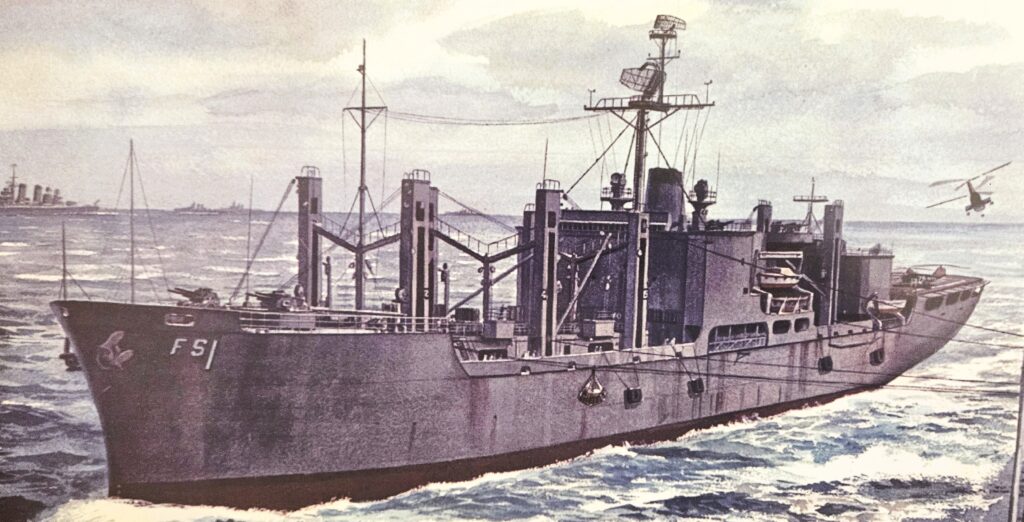
Just a few steps from the famous flying saucer sits another symbol of Mars’ unique identity—the bronze bell from the USS Mars (AFS-1), a U.S. Navy combat stores ship named after the Butler County community. The bell, which sits beside the newly errected flagpole in the town square, was donated to the borough in 2006 by former crew members after the ship was retired. Today it serves as a lasting connection between the small Pennsylvania town and the thousands of sailors who served aboard the vessel.


Commissioned in 1963, the USS Mars spent decades supplying American naval forces with food, fuel, mail, spare parts, and other essential cargo during overseas deployments. According to the historical display at the Mars Area History and Landmark Society, the ship earned numerous military decorations, including the Combat Action Ribbon, multiple Navy Unit Commendations, and 11 battle stars for service during the Vietnam War—before being decommissioned. The exhibit reminds visitors that while Mars is known for its playful connection to outer space, it also shares a proud connection to American naval history.
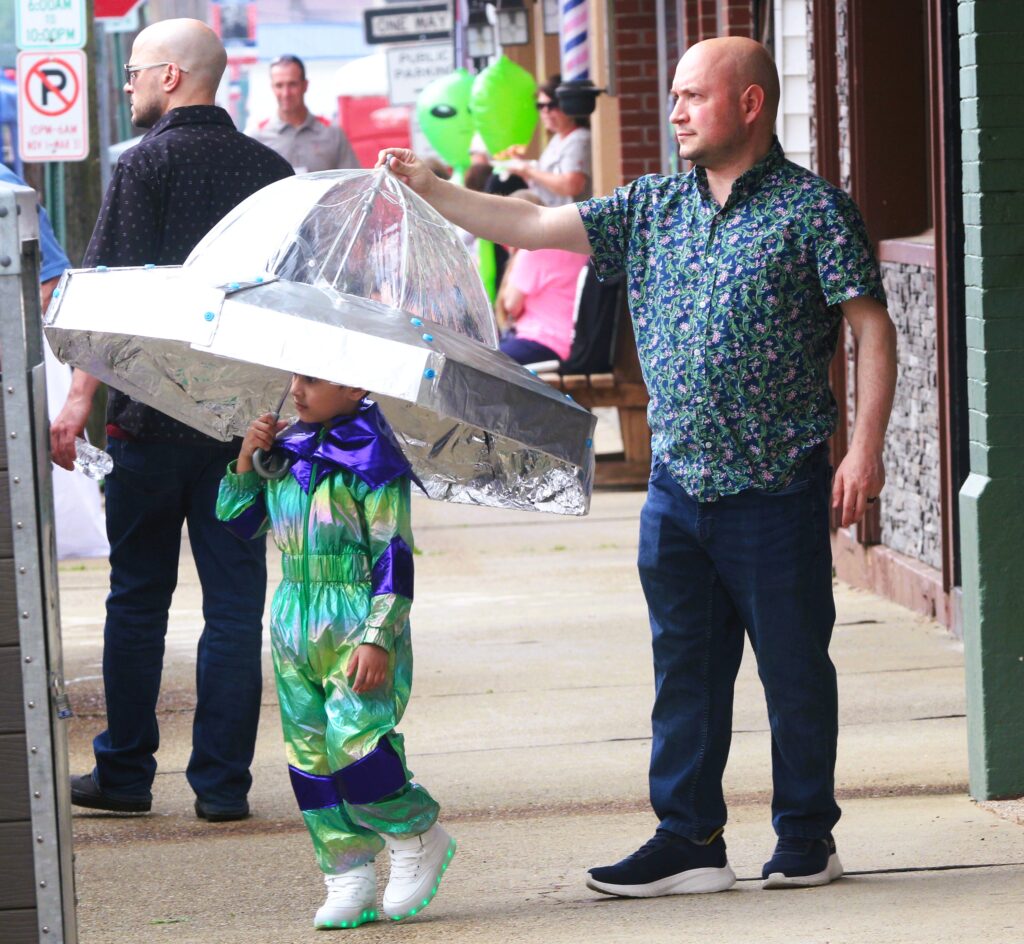

Mars’ space-themed identity extends beyond its landmarks. Every other year, the community celebrates the Mars New Year with a festival featuring a parade, food vendors, family activities, and costume contests that draw residents and visitors alike. The celebration reflects the community’s ability to embrace its unusual name while creating traditions that continue to strengthen its small-town identity.
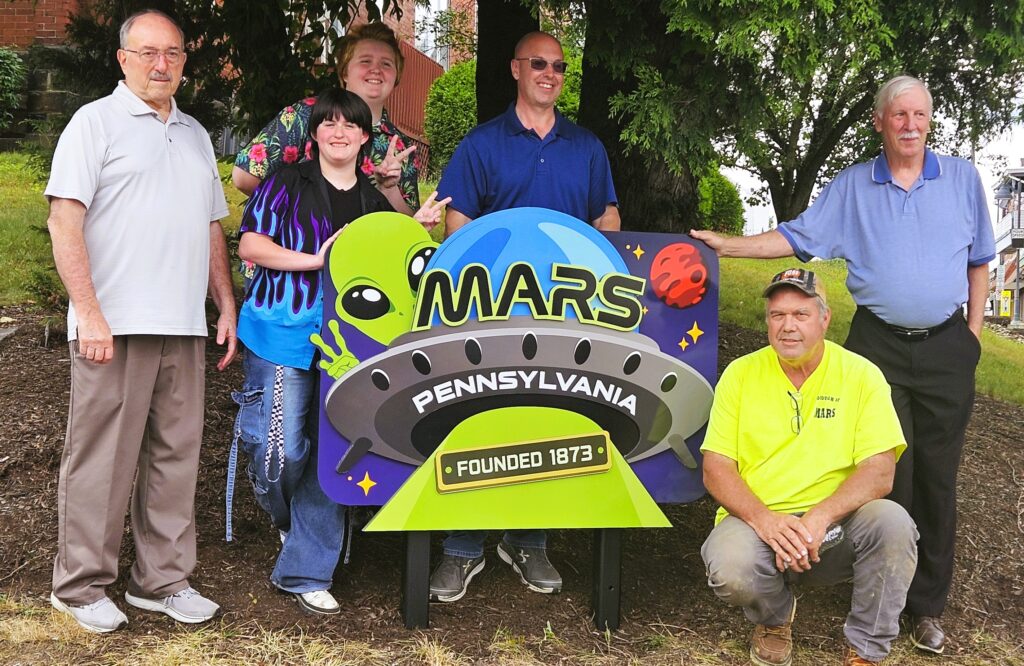

That commitment to preserving Mars’ identity continues today. Earlier this month, borough officials unveiled a new Mars gateway sign at the corner of Grand Avenue and Irvine Street, replacing a weathered landmark that had welcomed visitors for decades. Designed by students from the Butler County Area Vocational-Technical School and brought to life through partnerships with local businesses, the sign reflects the same community pride that has embraced the town’s unique name and history for generations.
Despite its sci-fi quirks, Mars maintains the feel of a quintessential American town. When asked to describe the culture, Mayor Hartung calls it “Small-town Americana—it’s a tightly knit community.” Watson offers a single-word comparison: “Mayberry.”
Looking Beyond the Merger
Both Watson and Mayor Hartung are confident that the merger will leave the town’s core identity intact while providing an opportunity for both communities to evolve.
“The town will always be here,” Hartung says.
Hartung acknowledges that regional changes are inevitable: “You know it’ll have some new elements to it, in terms of a broader area of service and understanding of who we are, collectively, as the Mars Area.”

However, he insists those elements are for the better. Hartung notes that the merger resolves a practical reality, as many Adams Township residents already consider themselves part of the Mars community—most already hold a Mars mailing address and will not need to change it post-merger. Watson adds that consolidation could spark a resurgence for the downtown business corridor as Adams Township residents feel a stronger connection to the borough’s center.
“To me, Mars is the heart of Adams Township,” elaborated Watson.
Watson points out that municipal restructuring is just another chapter in a long history of transitions. Once a booming oil and coal hub, downtown Mars saw commercial activity shift over the decades as Route 228 expanded and surrounding townships like Cranberry, Middlesex, and Adams experienced rapid growth.
“I’ve always felt, over the last decade or so, that the commercial end of Mars Borough hit rock bottom,” said Watson. “I mean, you want to keep things the same that we know, but that’s not life. You’ve got to roll with the bad and the good.”
Both leaders urge residents to stay connected with local history by visiting the Mars Area History and Landmark Center.
“Come visit! It’s all right here,” Watson noted.
Whether voters approve the merger this November or not, the people preserving Mars’ history believe one thing will remain unchanged: the community’s identity has always been defined less by its government than by the people who proudly call Mars home.