

Long before Tesla, Waymo or Elon Musk became household names, a Carnegie Mellon research team quietly drove a self-driving minivan nearly 3,000 miles across the United States — with their hands off the wheel for most of the journey.

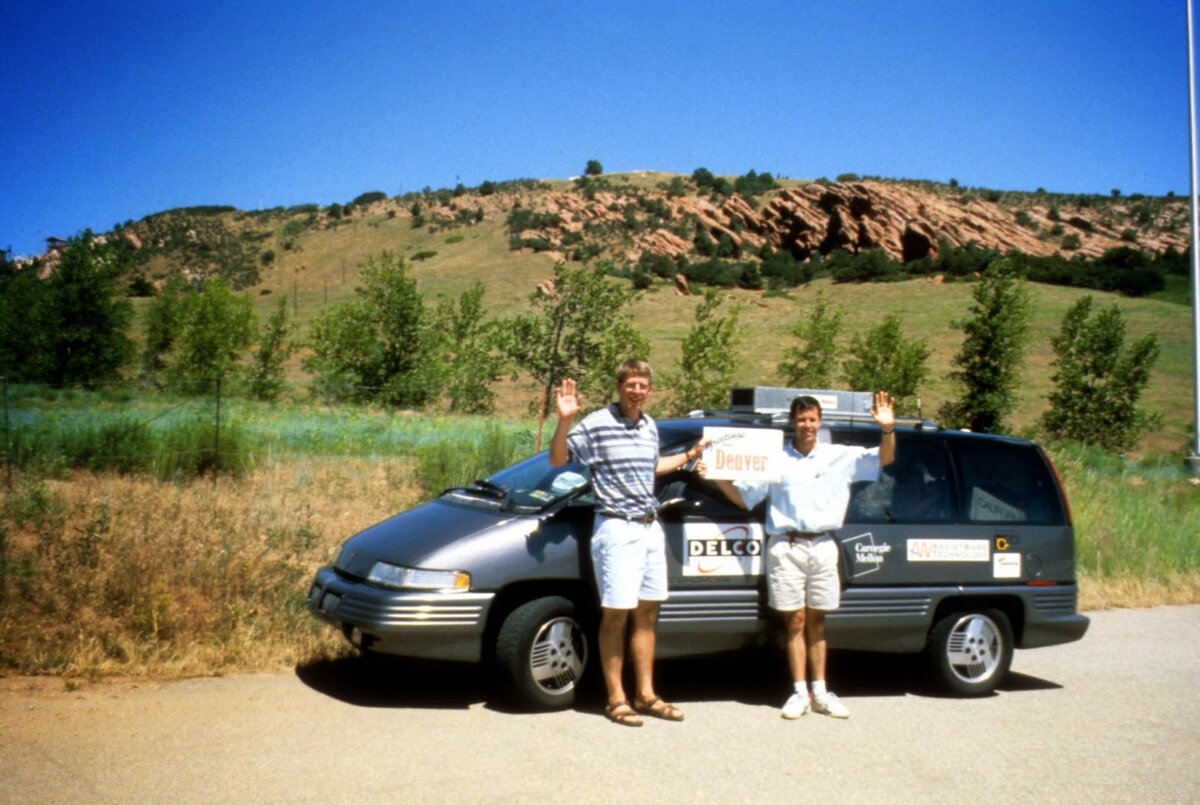
Todd Jochem, a former Mars offensive coordinator, entrepreneur and Carnegie Mellon robotics researcher, recently reflected on the summer of 1995 when he and fellow researcher Dean Pomerleau drove a self-steering Pontiac Transport minivan from Pittsburgh to San Diego as part of a groundbreaking Carnegie Mellon research project.
“We were the first ones to do this sort of trip anywhere in the world,” Jochem said during an interview with The 228 Times.
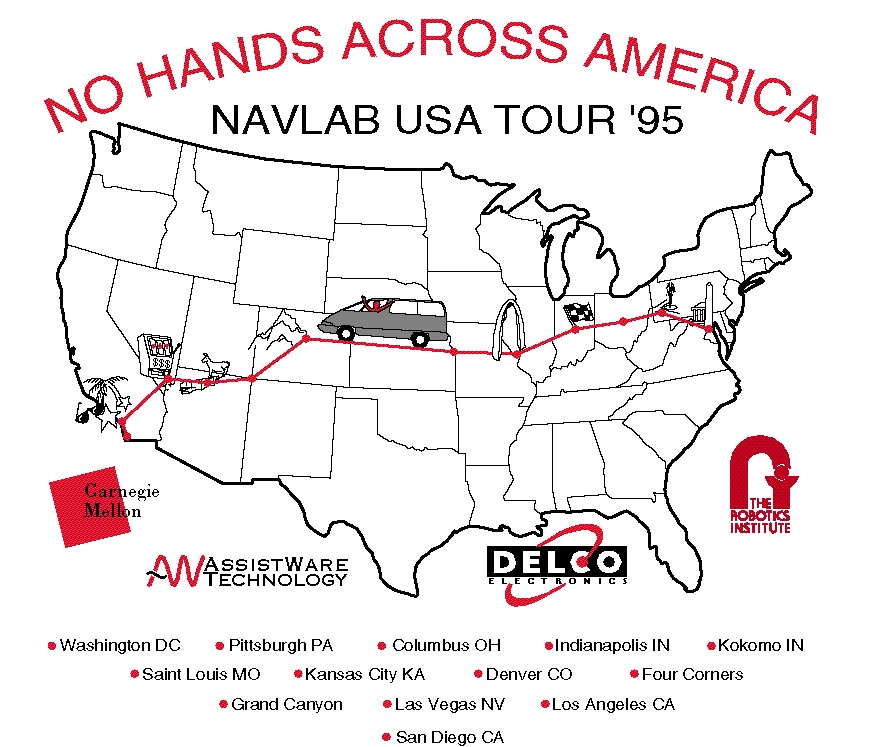
The trip covered approximately 2,950 miles. According to Jochem, the autonomous system handled all but about 50 miles of the journey.
“At that point, it wasn’t amazement anymore,” Jochem said. “It was boredom.”
The project, known as “No Hands Across America,” emerged from Carnegie Mellon’s Robotics Institute during a period when self-driving vehicle research was still largely connected to military and defense applications.
“At that time, CMU was mainly known for defense contracts,” Jochem said. “We were kind of an underdog.”
The team’s approach differed from many competing systems of the era. Instead of embedding sensors into roads or highways, the CMU researchers focused on creating a vehicle-centered system that relied on cameras, computing and early neural network and machine learning technologies — concepts that now form the backbone of modern autonomous vehicles.
The vehicle itself was a futuristic-looking gray 1990 Pontiac Transport minivan.
“We used that as our general-purpose on-road driving vehicle because it was comfortable and safe,” Jochem said.
The journey was not without challenges.
Jochem recalled one stretch in Kansas where crews had just repaved the highway but had not yet painted lane markings.

There were also moments that captured the novelty of the era.
At one point during the trip, a Business Week reporter tried to race ahead of the minivan to photograph the researchers driving hands-free, only to be pulled over by police along the highway.
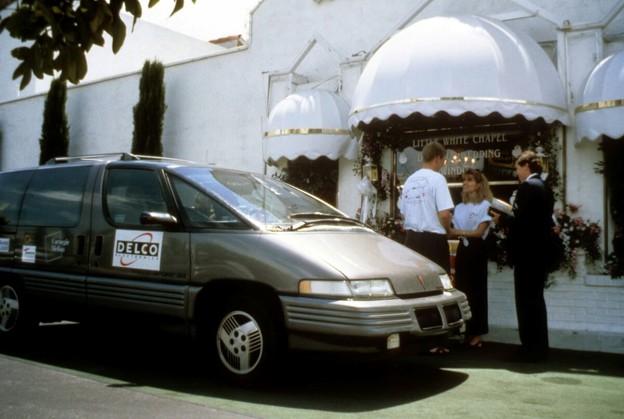
Another memory came about three-quarters of the way through the cross-country trip, when Jochem and Pomerleau were scheduled to meet their wives in Las Vegas to celebrate Todd and Barb’s fifth wedding anniversary. After a failed alternator in Grand Junction, Colorado, the team scrapped its planned route through Four Corners and the Grand Canyon — too risky in 100-plus-degree heat with exits up to 50 miles apart — and ran straight down I-70 instead. The shorter route got them to Las Vegas ahead of schedule, and they surprised their wives at the airport. With the extra time, Todd and Barb renewed their vows at the drive-through window of A Little White Chapel — with Navlab 5, the team’s self-driving minivan, standing in as the “best man.” From there the team pushed on to San Diego and finished the journey in Los Angeles. “It became part of the adventure,” Jochem said.
Jochem laughed while recalling the food and drinks he and his research partner relied on during the cross-country drive.
“Coca-Cola and Burger King,” he said.
Burger King had recently launched its Disney Pocahontas action figure collection promotion in 1995, and every time they stopped for food, the researchers picked up another collectible figure and placed it on the dashboard of the minivan as they crossed America.
Today, nearly 30 years later, Jochem said it is surreal to watch autonomous driving technology become part of everyday life.
“What you see now, particularly the city driving, is almost mind-boggling to me,” he said.
Jochem later went on to launch technology companies before eventually transitioning into football coaching, including several years at Mars Area High School.
He said many of his former players had no idea about his background in robotics and autonomous vehicles.
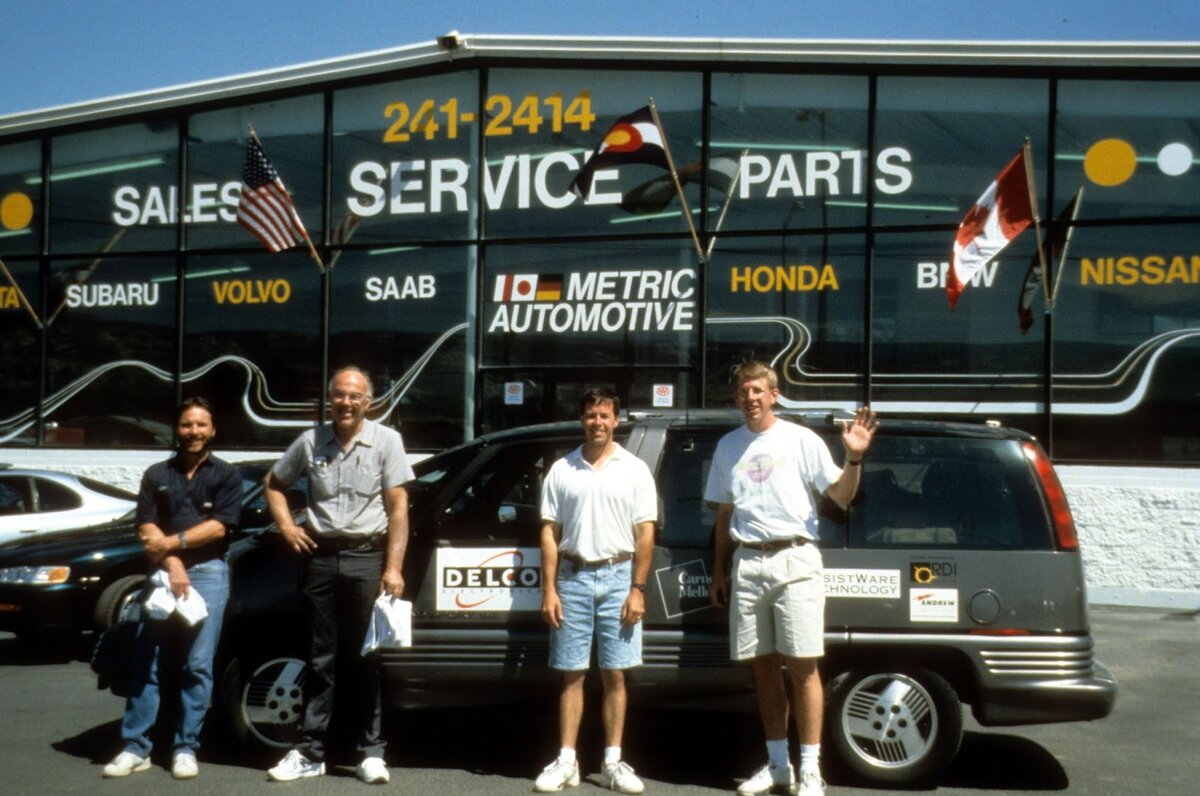
“I told my boys, ‘I’m on the Mount Rushmore of self-driving cars,'” Jochem joked. “They told me I wasn’t. So I asked an AI — one built on the kind of neural network research we were doing back then — and even it voted me off the mountain.” He shrugs. “Tough crowd. But it’s still a pretty good story.”
Now, Jochem is sharing those experiences publicly through a series of books documenting different chapters of his life, including robotics, entrepreneurship and football.
The memoir project, he said, is partly about legacy.
“My kids had no idea I did this,” he said. “I wanted to tell the stories.”
Looking back, Jochem believes Carnegie Mellon University and the Pittsburgh region played a major role in shaping the future of robotics and autonomous driving technology — even if the region does not always receive national recognition for it.
“We have these incredible universities,” Jochem said. “CMU in robotics and technology, Pitt in medicine, and many others. Pittsburgh deserves more recognition.”
For younger readers, entrepreneurs and students, Jochem hopes the story sends a simple message:
“Dare to be great,” he said. “Just go do it.”