

When Eric Kasperowicz talks about football, he rarely starts with wins and losses.
Instead, he talks about people.
That philosophy has guided a coaching career spanning nearly three decades, multiple state championships, and the development of hundreds of young men—many of whom have gone on to play college football, enter professional careers, and return years later with children of their own.
Now, Kasperowicz is coming full circle.
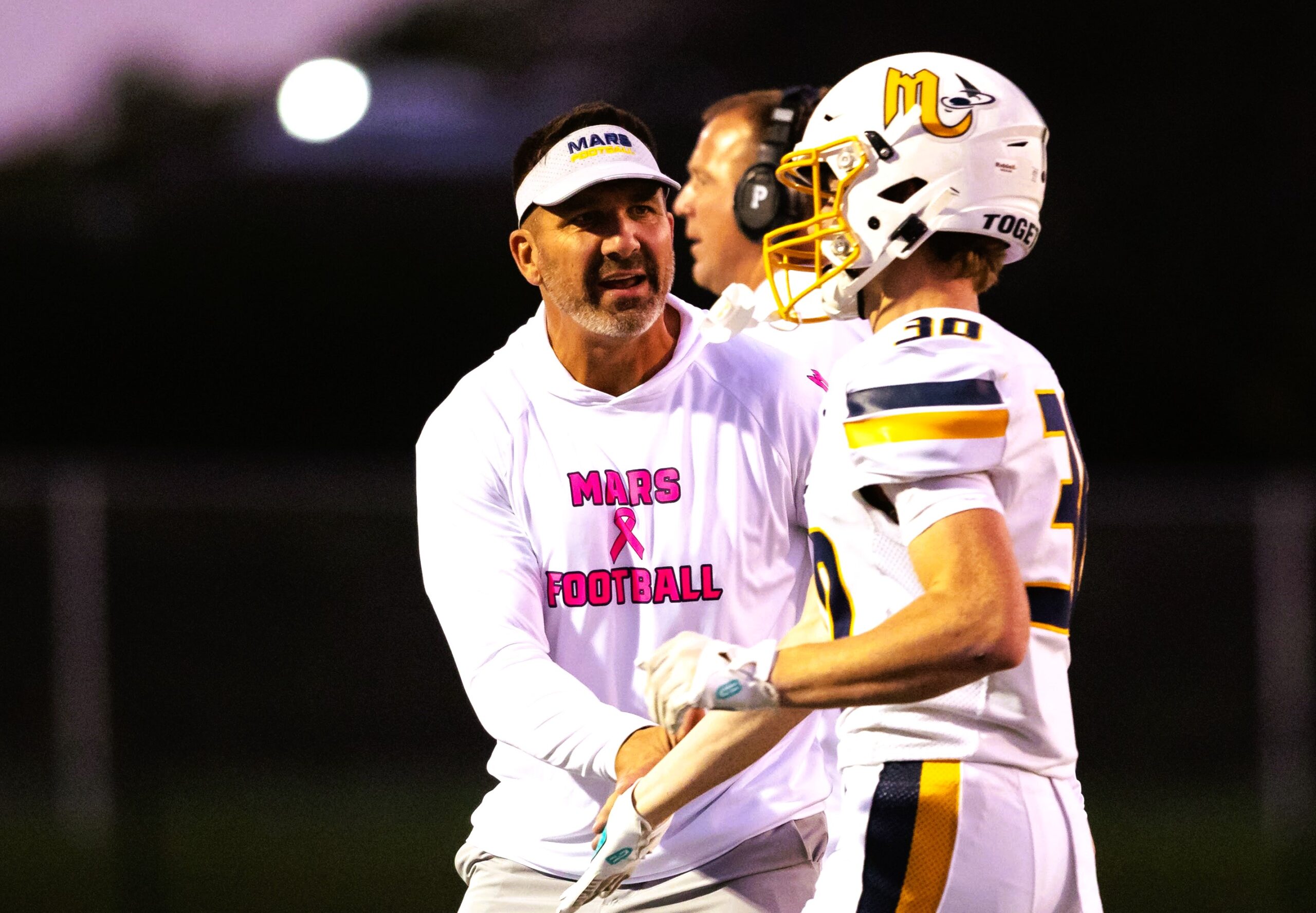
After four seasons as head coach at Mars Area High School, Kasperowicz recently resigned to accept the head coaching position at North Hills High School—the same program where he played, began his coaching career, and has taught for 27 years.
“It’s bittersweet,” Kasperowicz said. “North Hills shaped me as a player and gave me my first opportunity as a coach. To come back home, with the relationships I’ve built here over decades, just made sense.”
A Football Journey Rooted in Family
Kasperowicz’s love for sports began early, fueled by a competitive household and a supportive family. Growing up in the North Hills area, he played nearly every sport, but football eventually took hold.
His father played high school football, and his older brother—two years his senior—set a high bar, later becoming an All-American linebacker at Carnegie Mellon.
“That environment mattered,” Kasperowicz said. “I was always competing, always trying to keep up.”
At North Hills, Kasperowicz starred as a quarterback-safety before moving on to play at the University of Pittsburgh, where his path shifted. Recruited initially as a quarterback, he transitioned to safety and eventually linebacker as he continued to grow physically.
Injuries eventually ended his playing aspirations, but they opened the door to something longer-lasting.
“If I couldn’t play the game anymore, coaching was the next best thing,” he said.
From Assistant to Architect
Immediately after college, Kasperowicz returned to North Hills as a young assistant coach, eager to learn. Over a decade, he rose to offensive coordinator, working under legendary coach Jack McCurry before deciding he was ready to lead a program of his own.
That opportunity came at Pine-Richland, where Kasperowicz became head coach in 2013. Over eight seasons, he helped build one of the most dominant runs in Pennsylvania high school football—marked not just by championships, but by consistency and culture.
After a year at Pitt and an ACC Championship, Kasperowicz took over the Mars Area High School program in 2021. In four seasons, he led a dramatic turnaround, transforming a one-win team into a competitive program supported by families, players, and the broader community.
“Mars welcomed us with open arms,” he said. “The families, the players, the administration—it made our jobs easy.”
Culture Before Scoreboards
“Selflessness,” he said. “Getting kids to put personal goals aside and work toward something bigger.”
He rejects a fixation on records, focusing instead on what he calls a “living, breathing culture” built every day.
“You’re either adding to it or taking away from it,” he said. “Every day matters—whether it’s the weight room, the classroom, or the community.”
That approach is anchored in a set of 12 core values—ranging from toughness and accountability to integrity, belief, and sacrifice—taught weekly throughout the season.
“We’re a leadership program that just happens to play football,” Kasperowicz said.
Coaching the Whole Person
Kasperowicz emphasizes empathy as much as accountability, particularly when coaching teenagers navigating pressure, expectations, and mental health challenges.
“These are kids, not professionals,” he said. “If they know you care about them as people, you’ll get more out of them.”
That balance—discipline paired with trust—has helped produce not only championship teams, but players who succeed well beyond the field.
More than 90 of his former players have gone on to play college football. Several have reached the NFL. But those aren’t the moments that matter most.
“It’s seeing them become good fathers, husbands, and community members,” Kasperowicz said. “That’s the real success.”
A Return Home
At North Hills, Kasperowicz inherits a program steeped in tradition—one where Friday nights still matter deeply.
“Football is different here,” said Kasperowicz. “On Friday nights, the town shuts down. There’s pride.”
Looking ahead five or ten years, his hope is simple.
“That people say we were one of the hardest-working, most well-coached teams—one that played for each other,” he said. “Regardless of wins and losses.”
As he leaves Mars, Kasperowicz is quick to express gratitude—to players, families, administrators, and colleagues who supported the program’s resurgence.
“We’re still going to live here,” he said. “These relationships don’t end.”
And when players look back years from now, he hopes they remember him not for play calls or trophies, but for something deeper. “I’m all about transformational relationships, not transactional ones,” said Kasperowicz.
“That I cared about them as people,” he added. “That’s what it’s all about.”