

AMSTERDAM — There was a point not long ago when Blake Vogel thought his rowing career was over.
He had spent four years rowing at the University of Washington, worked his way into one of the nation’s premier collegiate rowing programs and won two national championships in Washington’s second varsity boat.
But Vogel hadn’t accomplished everything he set out to do.


So Vogel came home.
For about three months, the Mars native worked alongside his father and contemplated life after rowing.
Then a thought began bothering him.
What if, years from now, he watched athletes he had competed against — and sometimes beaten — rowing in the Olympics?
“I was like, I’ve been thinking about it. If I don’t do it, I’m going to regret it,” Vogel told The 228 Times from Amsterdam. “It’s like one of those what-if moments, down the line, I see people that I beat or I’m faster than in the Olympics. I’m like, that could have been me.”
Vogel decided he needed to find out.

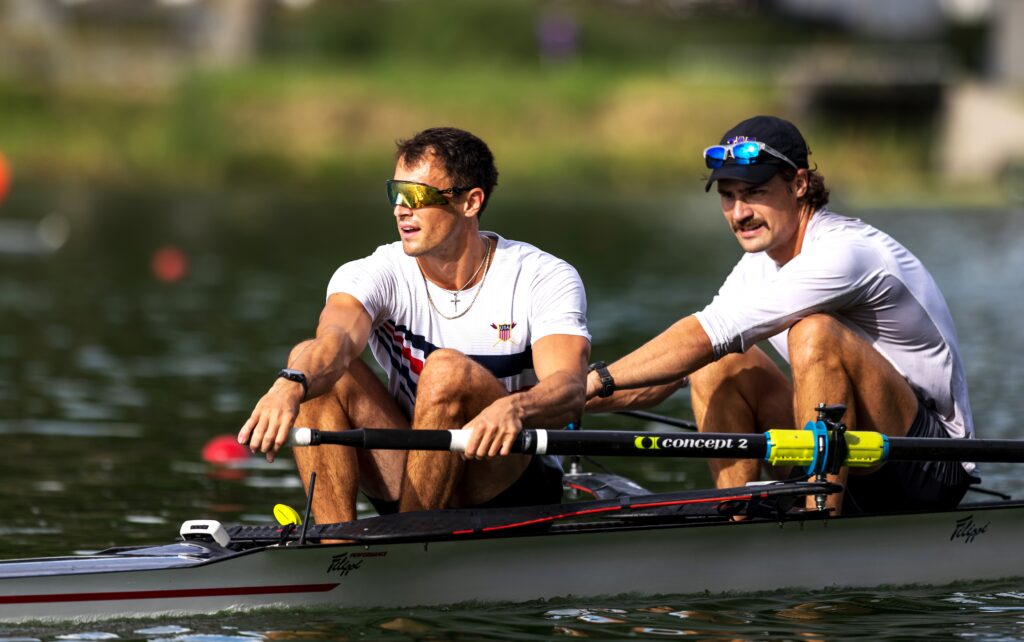
Today, the kid from Mars who once thought he was finished with rowing is in Amsterdam wearing USA across his chest.
Vogel and rowing partner Samuel Halbert will represent the United States in the men’s pair at the 2026 World Rowing Championships, scheduled Aug. 24-30 in Amsterdam. USRowing is sending 19 crews to the seven-day international competition.
USRowing’s official roster lists the men’s pair as Halbert, of Redmond, Washington, and Vogel, of Mars, Pennsylvania. Both rowed collegiately at the University of Washington.
For Vogel, Amsterdam represents another remarkable step in a journey that began almost by accident.
A suggestion from Mom
Vogel didn’t grow up dreaming about rowing.
He attended Mars before enrolling at Central Catholic in Pittsburgh and considered himself a lacrosse player. He also had competed in track.
His sister had taken up rowing while attending Oakland Catholic, and Vogel’s mother suggested he give the sport a try as a way of staying in shape while waiting for lacrosse season.
So he did.

“I started rowing my freshman year of high school,” Vogel said. “Through the fall and winter, found out I was pretty good. I was pretty fast on the erg … and I really fell in love with the sport.”
Eventually, Vogel had another conversation with his mother.
This time, he told her he wanted to give up lacrosse and concentrate on rowing.
Jay Hammond, who has coached rowing at Central Catholic since 2002, remembers Vogel as a focused athlete willing to put in the work.
“He was a good kid, a focused kid, and we were happy to have him,” Hammond told The 228 Times.
Vogel did all of the team’s required training and sometimes more, Hammond recalled. But the transformation that ultimately carried Vogel to the senior U.S. national team came after he left Pittsburgh for Seattle.
“He left our program as a pretty good guy,” Hammond said, “but after four years there, really returned as an international-level oarsman, which is pretty impressive.”
The decision to concentrate on rowing had carried Vogel from Pittsburgh’s rivers to one of the country’s premier collegiate programs.
Betting on Washington — and himself
Vogel wasn’t one of the country’s most highly recruited high school rowers.
His erg times weren’t as fast as he hoped, limiting his college options. He had conversations with several programs, but Washington was the school that consistently expressed interest.
For Vogel, there was another attraction.
Washington had a history of winning national championships and developing Olympic rowers.
“I wanted to go to a place where I can progress my rowing and win a national championship,” Vogel said. “Looking at all the other schools, UW was definitely the place to go.”
He headed nearly 2,500 miles from Western Pennsylvania to Seattle as a preferred walk-on.
There was just one problem.
Vogel arrived believing he was already on the team.
Then he learned he still had to survive tryouts.
“If I don’t make this team, then what am I going to do?” Vogel remembered thinking. “I’m going to be done rowing or I’m going to have to wait a whole year until I can try out again.”
The two-week tryout included tests both on the water and on land. His experience at Central Catholic helped separate him from many of the true walk-ons, and Vogel earned his place on the team.
Making the team produced another realization.
“Going into it, I thought that I was pretty good,” Vogel said. “It turned out that I was not.”
He found himself surrounded by freshmen who were faster, stronger and bigger.
Instead of discouraging him, the competition showed Vogel what was possible.
He watched Washington rowers who weren’t dramatically different from him win championships and compete internationally.
“That really gave me motivation being at this place that I can do it,” he said.
Hammond watched the progression from Pittsburgh.
Washington’s rowers essentially have to prove themselves again each season, Hammond said. Past accomplishments don’t guarantee a place in the boat.
“You have to earn it every single year,” Hammond said. “And he did that.”
Vogel didn’t merely survive.
“He got faster every year and was really competitive every year, and more and more so all the way through the four years,” Hammond said.
Grit
Years before Vogel reached Amsterdam, the University of Washington used one word to describe him:
Grit.
Growth mindset, committed service, humility and grit are identified by Washington athletics as four of the department’s core values. In a profile of Vogel during his collegiate career, Washington singled him out as a rower who personified grit.
It is a description Vogel still embraces.
At 6-foot-2, Vogel is tall by most standards.
Not necessarily by elite rowing standards.
Vogel said an ideal rower might stand 6-foot-5 or 6-foot-6. Being shorter means he has to compensate with fitness and strength to produce enough power to compete against larger athletes.
“I definitely consider myself gritty,” Vogel said, “because you need to be able to do a lot of work, a lot more than other people in order to get into the position that I’m in.”
Hammond explained why those few inches can matter.
Rowing speed depends partly on the length of the arc an athlete can create through each stroke, the force applied during that stroke and the number of strokes taken per minute. Taller athletes can generally create that long arc more easily.
For someone Vogel’s size, Hammond said, matching that stroke can require more work.
“You do have to just work a little bit harder,” Hammond said. “And I think that’s sort of always been his thing.”
Vogel traces some of that mentality back home.
He described growing up in a blue-collar family where work was simply expected. His father and brother worked blue-collar jobs, and Vogel remembers working for the family company and doing whatever work needed done around the house.
“There was definitely no days off in my household,” he said.
Washington magnified that work ethic.
Vogel steadily climbed through the program and spent his sophomore, junior and senior seasons in Washington’s top two boats. Although he never achieved his goal of racing in the varsity boat at the IRA National Championships, he won national championships in the second varsity boat during his junior and senior years.
Still, when his college career ended, Vogel wasn’t sure it was enough to justify continuing.
That’s when he went home.
And that’s when the Olympic question wouldn’t go away.
One more year
After talking with his parents, Vogel made himself a deal.
He would give elite rowing one year.
If he made the national team, he’d keep going. If he didn’t, he would reevaluate his future.
His parents encouraged him to take the chance.
Vogel moved to California to train and eventually teamed with Halbert, another Washington alumnus. The two finished second in a selection race in New Jersey, drawing the attention of national-team coaches.
Then came July 4.
Vogel and Halbert competed in the Summer Speed Order, where rowers from around the country race for an opportunity to advance in the national-team selection process.
They knew they were fast.
Their training partners included an Olympic bronze medalist and another athlete who had competed on the previous year’s world team.
Vogel and Halbert had spent months going “toe-to-toe” with them.
“We knew going into the race that we were pretty quick,” Vogel said. “And we also knew that on a given day we could beat them.”
They did.
Their victory earned them an automatic invitation to a two-week selection camp in Princeton, New Jersey.
For two weeks, Vogel didn’t know whether the gamble he’d made after leaving Washington was about to pay off.
“I had no idea where I stood,” he said. “I had no idea whether I was going to get cut or if I was going to make the team.”
Finally, coaches called Vogel and Halbert together.
They were going to Amsterdam.
They would be the United States men’s pair at the World Championships.
The accomplishment isn’t lost on Vogel’s former coach.
Thousands of athletes participate in rowing across the country, Hammond said. Yet only a small number of men earn places in the boats representing the United States at this level.
For Hammond, Vogel is now the third athlete he has coached at Central Catholic to reach the senior U.S. team.
“It’s a really, really impressive achievement to have made the senior … U.S. senior team,” Hammond said. “Especially for a guy that size.”
And Vogel hasn’t been forgotten by the program where his rowing career started.
Central Catholic’s current rowers know exactly who he is.
“He’s our boy,” Hammond said.
Setting the tone
When Vogel and Halbert line up against the world’s best pairs in Amsterdam, Vogel will occupy one of the most consequential positions in the boat.
Vogel told The 228 Times he will row from the stern in the stroke seat, where he will set the rhythm for the pair. Halbert must match Vogel’s cadence as the two try to synchronize every stroke down the 2,000-meter course.
Vogel also said he will steer the boat, using the pair’s steering mechanism while simultaneously maintaining the rhythm and power required to race.
For Hammond, putting Vogel in the stroke seat makes sense.
He sees the position as another reflection of the quality that has carried Vogel from an unheralded high school rower to the U.S. national team.
Tenacity.
“You want to have someone like that who’s very, very tough in the stroke seat, setting the rhythm,” Hammond said, “because that’s the guy that sort of sets the tone for the boat.”
For roughly six-plus minutes, there is nowhere to hide.
Rowing, Hammond explained, combines endurance with power. Elite athletes can train 11 or 12 times a week, often twice a day, spending far more time preparing than actually competing.
And in the men’s pair, there are only two rowers.
Every stroke matters.
For Vogel, the responsibility will be to help determine how those strokes are taken — and where the boat goes.
Wearing USA
For someone who grew up in Mars, attended Central Catholic and crossed the country to chase a rowing dream at Washington, there is significance in what Vogel will wear when he takes to the water in Amsterdam.
USA.
“It makes me very proud to be an American and to be able to have this opportunity,” Vogel said.
Vogel isn’t predicting a medal.
He and Halbert are entering an exceptionally deep men’s pair field, where many countries put some of their strongest athletes into the two-man boat.
For their first senior World Championships, Vogel has established a realistic target.
“The expectation is to get in the A final,” he said. “I think if we can get in the A final, that’d be really exciting and really good because the boat class that we’re in is very competitive.”
A medal?
“I would be amazed if we can get a medal,” Vogel said, “but I’ll be very satisfied with the A final performance.”
Vogel and Halbert have been training in Amsterdam ahead of competition, tapering their workload after weeks of intense preparation.
Vogel said an elite rower’s actual workout time can reach about 20 hours a week — not including travel, warmups and other preparation. Several weeks before an important race, athletes increase the workload significantly before tapering in the final days so their bodies can recover and peak for competition.
Asked whether his mother ever reminds him that rowing began because she suggested he try it to stay in shape for lacrosse, Vogel laughed.
“All the time,” he said.
And then:
“I always tell her that she’s the reason why I’m here.”
Los Angeles
Amsterdam isn’t the destination Vogel ultimately has in mind.
During his interview with The 228 Times, Vogel was asked what the younger Blake — the kid from Mars just beginning to row — would think about the man now preparing to represent his country at a World Championship.
Vogel didn’t say his younger self would be impressed.
He said the younger Blake would have a question.
“I think my younger self would ask if I’m going to keep going, if I’m going to go for LA.”
The answer?
“I’m going for it.”
The 2028 Olympic Games in Los Angeles are the dream.
The national championships, the setbacks, walking onto Washington, nearly walking away from rowing altogether, earning a place on Team USA and now competing in Amsterdam — Vogel sees all of it as part of something that isn’t finished yet.
They are stepping stones, he said, toward the ultimate goal.
Los Angeles.
Photos: Blake Vogel and Samuel Halbert train in Amsterdam ahead of the 2026 World Rowing Championships. Photo credit: Row2k.com