

Social media rumors that Mars Area School District was selling student information prompted questions at a recent school board meeting and additional concerns from a parent who contacted The 228 Times, leading district administrators to clarify how student information is handled under federal privacy law.


The clarification follows concerns raised during an open discussion at the Aug. 18 school board meeting, when a parent questioned district officials about social media rumors that the school was selling students’ personal information. Gross, with additional explanation from the district solicitor, told those attending that the district was not selling student information.
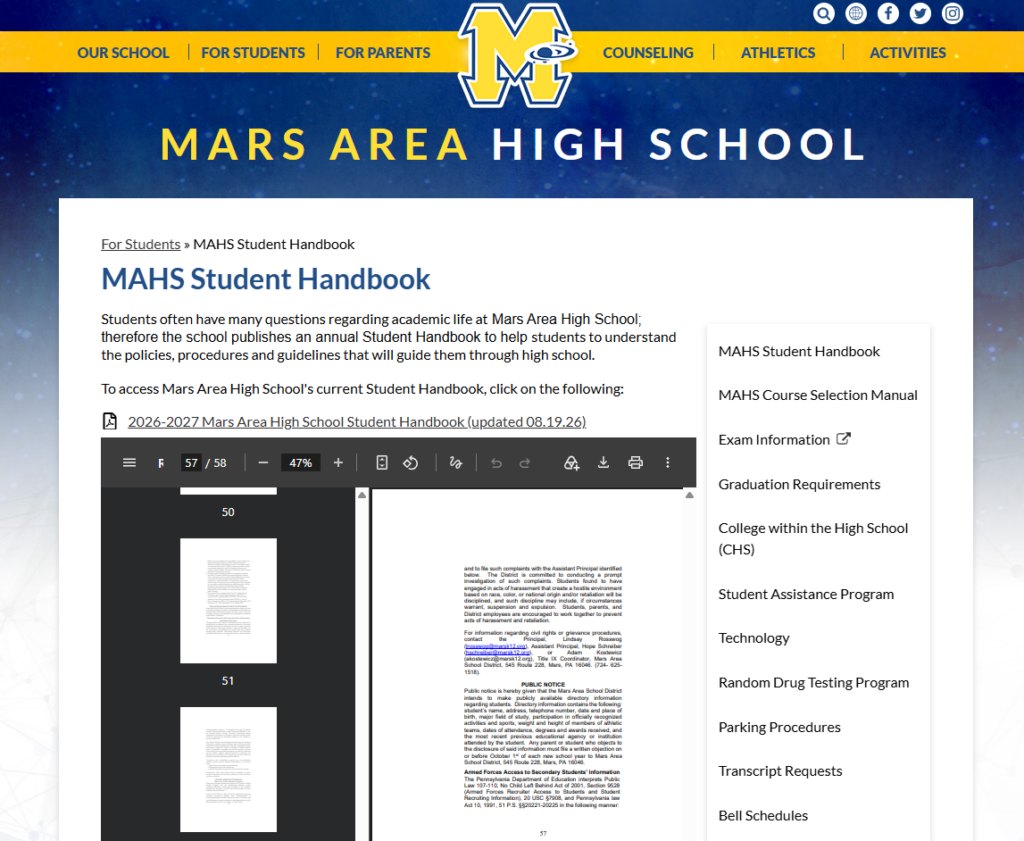
The issue resurfaced when Mars parent Devin Woods contacted The 228 Times after reading the handbook language and receiving a response from his child’s principal. Woods said the wording left him concerned that parents might have to permit broad disclosure of their children’s information for them to appear in yearbooks, honor rolls and other school-related recognition.
Gross said the handbook passage is an annual notice required under the Family Educational Rights and Privacy Act, commonly known as FERPA, and does not represent a change in district policy or practice.
“The annual FERPA notice in the handbook is a federally mandated notification and does not represent a change in District policy, protocols, or procedures,” Gross wrote in an email to The 228 Times.
WHAT FERPA ALLOWS

The law also permits school districts to designate certain records as “directory information,” which may be disclosed without individual consent after parents and eligible students receive notice and an opportunity to opt out.
Gross provided The 228 Times with the district’s list of information classified as directory information. It includes a student’s name; address; date and place of birth; major field of study; participation in officially recognized activities and sports; weight and height of members of athletic teams; dates of attendance; degrees and awards received; and the most recent previous educational institution attended by the student.
Education records and personally identifiable information generally cannot be disclosed without written consent from a parent or eligible student, according to the district’s explanation. Gross said written consent must identify the records that may be disclosed, state the purpose of the disclosure and identify the parties to whom the disclosure may be made.
In response to a direct question from The 228 Times, Gross said the district does not sell student information, has never sold it and has never received payment for providing student information to another party.

“We don’t indiscriminately just turn over that information,” Gross told the board.
He cautioned, however, that a broadly written opt-out request could affect the district’s ability to include a student in common school publications and recognition programs.
“We won’t put the picture in the yearbook. We won’t place the name in the yearbook,” Gross said.
He also cited graduation programs, honor rolls, awards, school publications and media recognition as examples that could be affected by an opt-out request.
The board discussion also addressed the distinction between companies providing educational services to the district and businesses seeking student information for marketing. Using Pepsi as an example, a board member asked whether the district would provide student information to help the company market products to students.
“We wouldn’t because they have no educational interest in the child,” Gross responded.
Separate from the disclosure of directory information, district officials said Mars sometimes must provide limited student information to outside companies that perform educational or operational services for the district, such as educational-software providers and student-management systems. Gross said those disclosures must serve an educational purpose.

Gross reiterated that the annual notice should not be interpreted as giving the district broader authority to release student information.
“Nothing in the annual notice should be interpreted as expanding the District’s authority to disclose student information or as changing the District’s existing practices,” he wrote.

HOW PARENTS CAN LIMIT DISCLOSURE
Parents and guardians who do not want the district to disclose designated directory information may submit a written opt-out request. Because Mars does not have a district-created form, Gross directed families to an opt-out form developed by the Education Law Center of Pennsylvania.
Gross said documenting the request in writing allows parents to define its scope and helps the district apply it consistently.
“The scope of an opt-out can have practical implications for a student’s participation in a variety of ordinary school activities and programs,” Gross wrote.

Gross said those possible consequences are not intended to discourage parents from exercising their right to opt out. Rather, he said, parents should understand how a broadly written request could affect the district’s ability to identify or recognize their children publicly.
“This is not intended to discourage a parent or guardian from exercising the right to opt out,” Gross wrote. “Rather, having the request clearly documented in writing helps the District understand precisely what the parent or guardian intends to restrict.”
Woods subsequently met with Gross and the Mars Centennial School principal.
“It seems that it was just an issue with the verbiage being recently discovered in the student handbook, and not very well stated,” Woods said.
Woods said he believed the handbook language could give parents an inaccurate impression about how the district uses student information. District officials had addressed the issue publicly at the Aug. 18 school board meeting, and Woods said Gross’ subsequent explanation of directory information and FERPA protections largely resolved his concerns.
During the August meeting, administrators acknowledged that the handbook language could be difficult to understand. After one participant suggested that the district clearly identify the passage as a notice required by federal law, officials agreed to consider adding clarifying language.
Gross said the current handbook will not be changed during the school year because it is published annually. The district plans to add the statement “The following annual notice is required by federal law” when the handbook is revised for next year.
In a follow-up response, Gross said directory information is typically provided upon request to colleges, universities, schools receiving a transferring student and scholarship sponsors. He emphasized that the district discloses information only for educational purposes as outlined in district policy.
Gross also said parents may restrict disclosure to outside organizations while continuing to allow their child to appear in yearbooks, honor rolls, awards programs, graduation materials and athletic or extracurricular publicity.
“Absolutely,” Gross wrote. “All of those are for educational purposes.”
HOW THE DISTRICT HANDLES STUDENT PHOTOGRAPHS
Student photographs are handled separately. Gross confirmed that photographs are not included in the district’s published list of FERPA directory information. Instead, the district has a separate notice governing the use of student photographs in district publications, on its website and social media, and by local media.
Under that notice, parents or guardians who do not want their child photographed for publicity purposes are instructed to notify the building principal in writing by Sept. 30. Gross also said the district’s social media policy permits photographs, videos and livestreams of students unless a parent or guardian has opted the student out of directory-information sharing or declined to sign the district’s release form.
Gross said the district remains committed to protecting student privacy, respecting families’ rights under FERPA and complying with applicable laws.
“In summary, the annual notice reflects a federal requirement — not a change in Mars Area School District policy or procedure,” he wrote.