

Rodney Phillips was 19 years old when the idea first arrived.
He was working in the back of a furniture store, waiting for customers to pick up their purchases, when a story began forming in his head. With nothing but stock cards nearby, he started scribbling notes on their backs. Soon, those cards gave way to legal pads. Then notebooks. Eventually, entire handwritten chapters filled folders tucked away in a filing cabinet.
At the time, Rodney was just beginning college. He was an athlete who played football, baseball, and basketball — but he also loved to write. Short stories. Poems. Bits of dialogue. Writing was always there, quietly competing with practices, classes, and life.
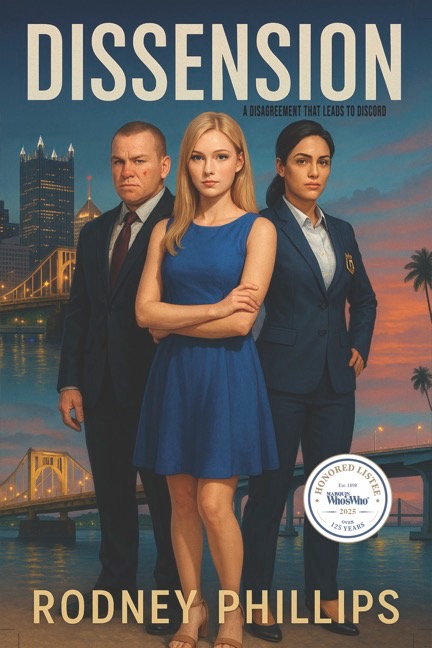
That early spark became the foundation for what would one day become his debut novel, Dissension. But that day wouldn’t come for another 37 years.
Life, as it tends to do, stepped in.
Rodney went to Penn State Behrend before returning home to help care for his mother. He completed his degree at California University of Pennsylvania (now PennWest California) in computer-based systems management. He built a career that eventually led to pharmaceutical sales. He married, raised two children, coached football and boys’ and girls’ lacrosse for more than two decades, and spent countless weekends on sidelines instead of at a keyboard.
Every so often, he would pull it out. Once or twice, he tried to restart — but the sheer volume of handwritten material felt overwhelming. After reading through pages of old notes, he’d put everything back away.
Until one weekend, years later, when his house suddenly became very quiet.
Both kids were away at college. Rodney had stopped coaching. And his wife gently suggested he find something to do.
So he opened the cabinet.
“All those notebooks we’ve been carrying around?” she asked.
“Yes,” he said.
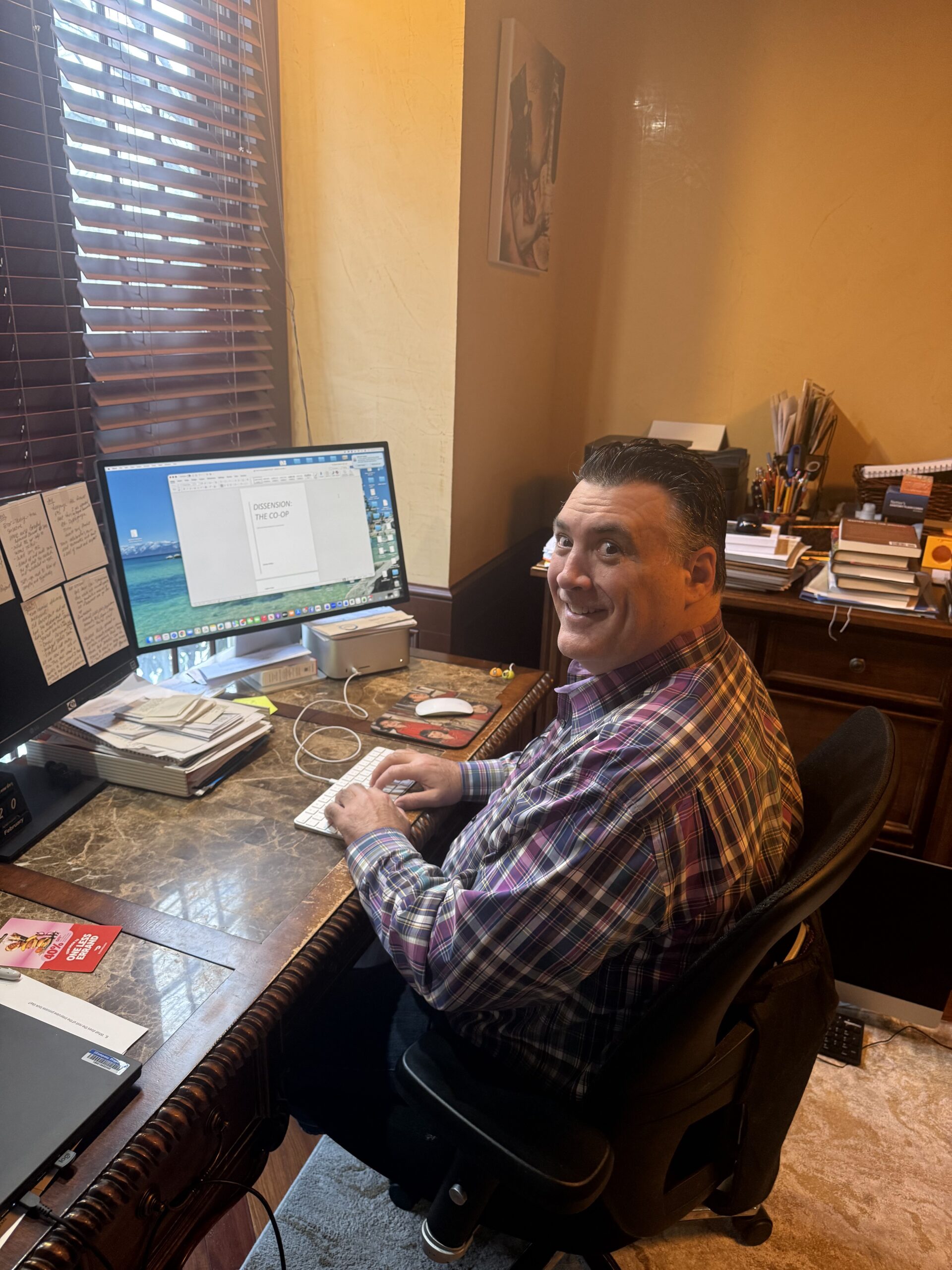
He began typing every handwritten word into a Word document — even passages he knew would eventually change. That process alone took nearly two months, working only on weekends. After that, he spent about a year revising, expanding, and reshaping the story.
He calls himself a “weekend writer.”
Saturday mornings became appointments with his book: coffee in hand, door closed, laptop open. If ideas came during the week, he stored them in his phone. On weekends, he turned those notes into scenes.
What surprised him most was how much of his teenage vision remained intact.
“The backbone of the story stayed,” he said. The characters were still there. The core twists still worked. But now, decades of life experience could be layered on top — deeper emotional arcs, themes of loyalty and disloyalty, communication and conflict, growth and consequence.
“I don’t think the book would be as good if I had finished it at 19,” Rodney said. “Now I could infuse my life lessons into the characters.”
Even his son played a role in shaping the finished version. Originally, Rodney had set part of the story in Las Vegas. His son, then 19 himself, questioned why drug cartels would operate there instead of Miami or Texas. Rodney listened — and rewrote the setting.
It felt poetic: a 19-year-old helping refine the work his father began at the same age.
Books had always mattered deeply to Rodney, and that love traces back to childhood.
His grandmother used to read to him before bed. She passed away when he was young, but the ritual stayed with him. He grew into an avid reader, finishing several books a month, preferring physical copies he could hold and flip through.
That early gift — stories shared aloud — became the quiet engine behind everything.
When Rodney finally finished Dissension, he first shared the manuscript with his wife, Monica — an avid reader — along with a small group of friends. Their reaction surprised him. They connected with the characters. They cared about the story. Their encouragement helped push the project forward. Phillips is also quick to credit his children — daughter Kailey, 22, and son Dylan, 20 — for their support along the way. Dylan even helped reshape part of the story, suggesting a major location change that ultimately strengthened the plot.
Encouraged, Rodney submitted the manuscript to four publishers that accept new authors. One declined almost immediately. The other three wanted it.
He and his wife took virtual meetings with all three before choosing a Pittsburgh-based publisher.
Soon after, editors asked a question he never expected: did he have ideas for a sequel?
Now he’s writing one — again, on weekends — with a third book already forming in his mind. He envisions a trilogy that circles back to the beginning, much like his own journey.
The novel itself follows Kylie Lynn Morgan, a criminal law student at the University of Miami who becomes trapped in a violent conflict between rival drug cartels. As danger closes in, she’s forced to grow from ordinary college student into survivor. Rodney was intentional about creating strong female characters, inspired by his daughter and years of coaching girls’ lacrosse — women who stand on their own in a male-dominated world.
For Rodney, finishing the book represents more than publication.
It’s proof that dreams don’t expire.
“As a teenager, I wanted to be an author,” explained Rodney. “Even at 56, I was able to go back and accomplish that.”
He hopes his story encourages others who may have unfinished manuscripts tucked away in drawers.
“If it’s important to you, make it a priority,” Rodney said. “I made an appointment with my book.”
Looking back, revisiting his 19-year-old writing was emotional. Reading his own words decades later brought memories flooding back. The bones of the story were there — they just needed modern details, new perspectives, and time.
If his younger self were sitting beside him today, Rodney imagines he’d be proud.
“We did it,” he said.
Sometimes, stories just need a lifetime to be told.
—-
Phillips will host a book signing at Masterpiece Creations Art Gallery on Sunday, March 22, 2026